Description of projection model
The long-term projections are made using the long-term projection (LTP) model of the Finnish Centre for Pensions. The projections on pension expenditure cover statutory pensions, that is, earnings-related pensions, the national pension, the guarantee pension and special provision pensions. The model is also used to make projections regarding the financing of earnings-related pensions.
The Employees Pensions Act (TyEL) has been modelled as if it were managed by only one pension provider. This provides information and estimates of the average TyEL figures. However, the LTP model does not examine the position of individual pension providers.
The LTP model consists of several interconnected modules, as presented in the figure below.
Structure of the LTP model
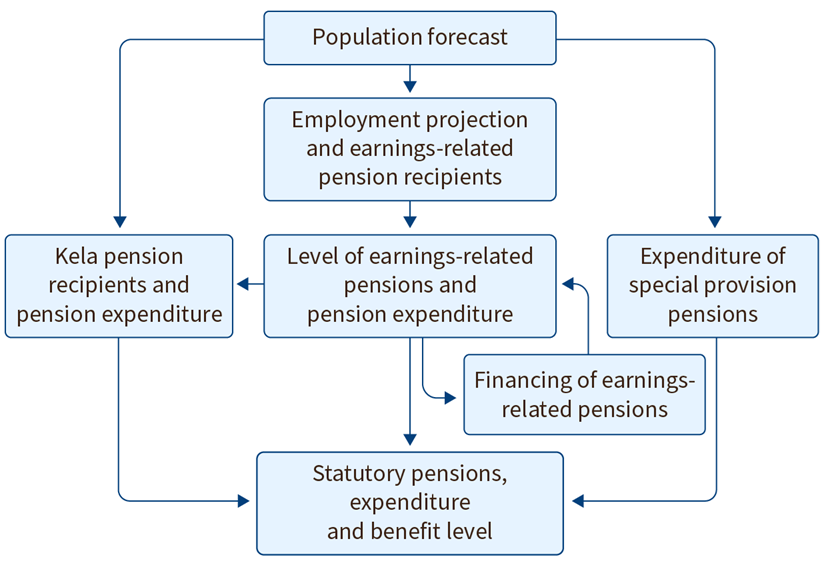
The population projection determines the number of people of a pensionable age. Together with the employment forecast, it determines the size of the labour force. The number of retirees and the pension amounts together determine the pension expenditure.
The earnings-related pension expenditure is calculated separately for each pension act. The pension schemes under review are those for private sector employees (TyEL), the self-employed (YEL), agricultural entrepreneurs (MYEL), Keva’s member corporations, State employees, and other minor schemes. In addition, system-specific financing projections are made, for example, to estimate the required TyEL contribution rate.
An averaging technique by pension act, age and sex is applied in the projections. For example, all working men aged 50 and covered by TyEL receive an equal wage. The averaging technique is technically simpler than the individual-level technique. However, the averaging technique does not provide information on the size distribution of pensions. Such results are obtained using the ELSI microsimulation model.
For the projection of national pensions, information on the current pension distribution as well as the projected distributions generated by the ELSI model are used.
Special provision pensions are determined based on the population forecast. The starting point for the projection is the current special provision pension expenditure, divided by age and gender. The total statutory pension expenditure is calculated as the joint result of the different modules.