Partial old-age pension claimants mostly satisfied with their choice

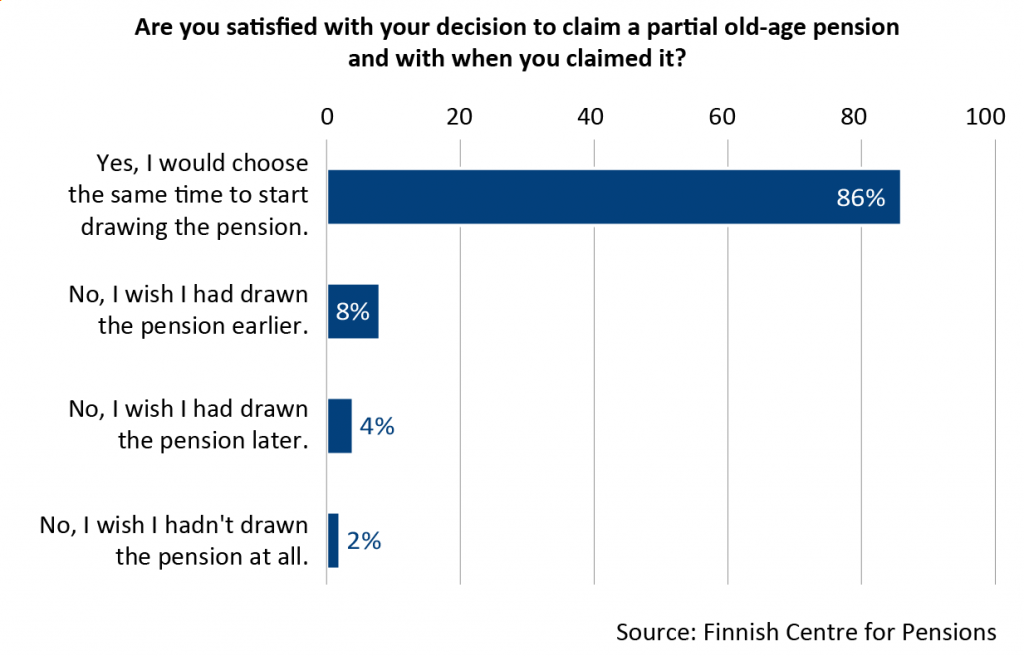
Around 90 per cent of people who have claimed a partial old-age pension are satisfied with their choice. The most common reasons for claiming the pension are its financial profitability and the claimants’ uncertainty about their health and remaining life expectancy. In the first large-scale survey of its kind, the Finnish Centre for Pensions examined the experiences of people who had claimed a partial old-age pension.
Around 70 per cent of respondents felt that claiming a partial old-age pension was financially profitable. Almost as many said that uncertainty about their health or remaining life expectancy had influenced their decision.
Financial need, health-related reasons and uncertainty about the pension system were more common reasons for claiming a partial old-age pension among those whose financial situation or health was poorer.
“For people in a more advantaged position, such as those with a higher level of education, the pension was more often seen as a financially profitable opportunity to benefit from the flexibility of the system or to receive additional income for saving or investing,” says Satu Nivalainen, Economist at the Finnish Centre for Pensions.
Uncertainty about the future has increased
According to the survey, uncertainty about the future as a reason for claiming the pension has increased markedly in recent years. Nivalainen says that many people may claim a partial old-age pension because they are unsure whether their health and ability to work will remain sufficient until their retirement age.
“Public debate about pensions and pressure to reform the pension system may also have caused concern,” she explains.
The desire for additional income influenced most respondents’ pension decision
Reasons related to additional income influenced the decision to claim the pension among around 80 per cent of respondents. The most common single reason was the desire for additional income to cover daily expenses. This influenced the decision of more than 40 per cent of claimants. Many also needed additional income because of various financial difficulties.
Sixty per cent of respondents wanted to reduce their working hours, although their reasons varied. The most common reason was the desire to reduce their workload, which influenced the decision to claim the pension among 45 per cent of respondents.
The impact of the pension are fairly well understood, but knowledge differs between population groups
People who chose the partial old-age pension generally understand its impact well. Around 90 per cent had checked the amount of their partial old-age pension and knew that it permanently reduces their full old-age pension.
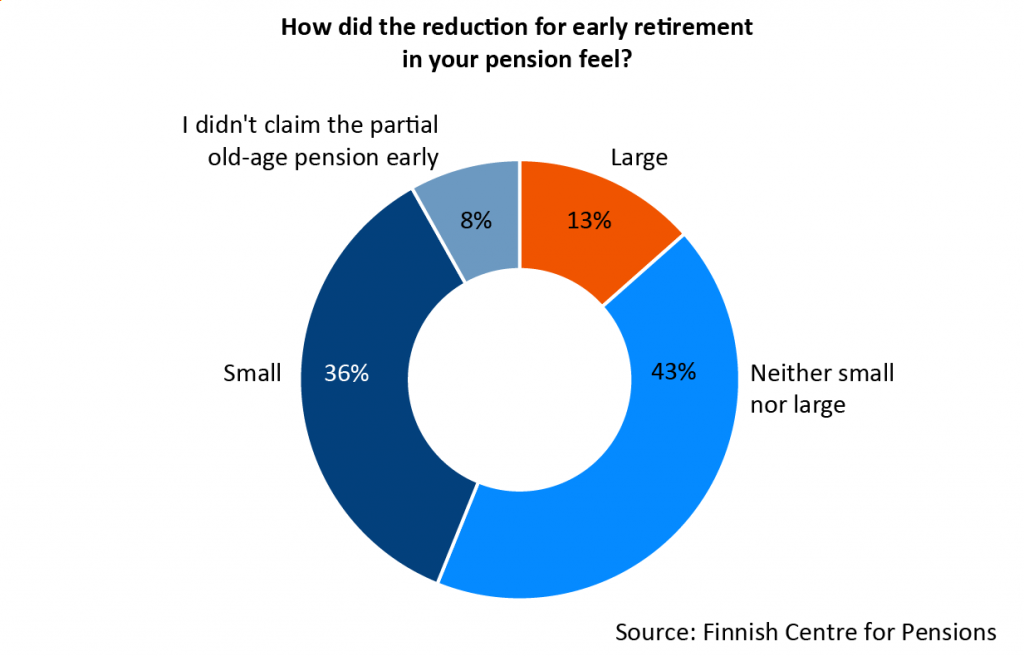
Only a few respondents considered the reduction for early retirement in their partial old-age pension to be large. Just over one in ten held this view, while more than one in three considered the reduction to be small.
A less well-known fact is that the partial old-age pension can also be claimed after the minimum retirement age. Around two thirds of respondents knew that claiming the pension could be deferred.
There are also clear differences in knowledge between population groups.
“People in a weaker financial position or with poorer health were more likely than others to have made their pension decision on the basis of incomplete information, at least to some extent,” Nivalainen says.
The study is based on a survey conducted in late 2025 among people who started drawing a partial old-age pension between 2019 and 2024. Around 3,000 people responded to the survey (response rate: 59%).
Research publication: Persons who chose the partial old-age pension – reasons for, knowledge about and satisfaction with claiming the pension (Summary in English)
One in three chooses the partial old-age pension
The partial old-age pension has proved popular. By the end of 2025, one in three eligible people born between 1959 and 1962 had claimed the pension.
Read more about the partial old-age pension on the website Työeläke.fi