Persons insured for an earnings-related pension in Finland

The statistics describe persons insured under the Finnish earnings-related pension scheme, as well as the insured earnings of employees and the insured incomes of self-employed persons.
Persons insured for an earnings-related pension in Finland, 2025
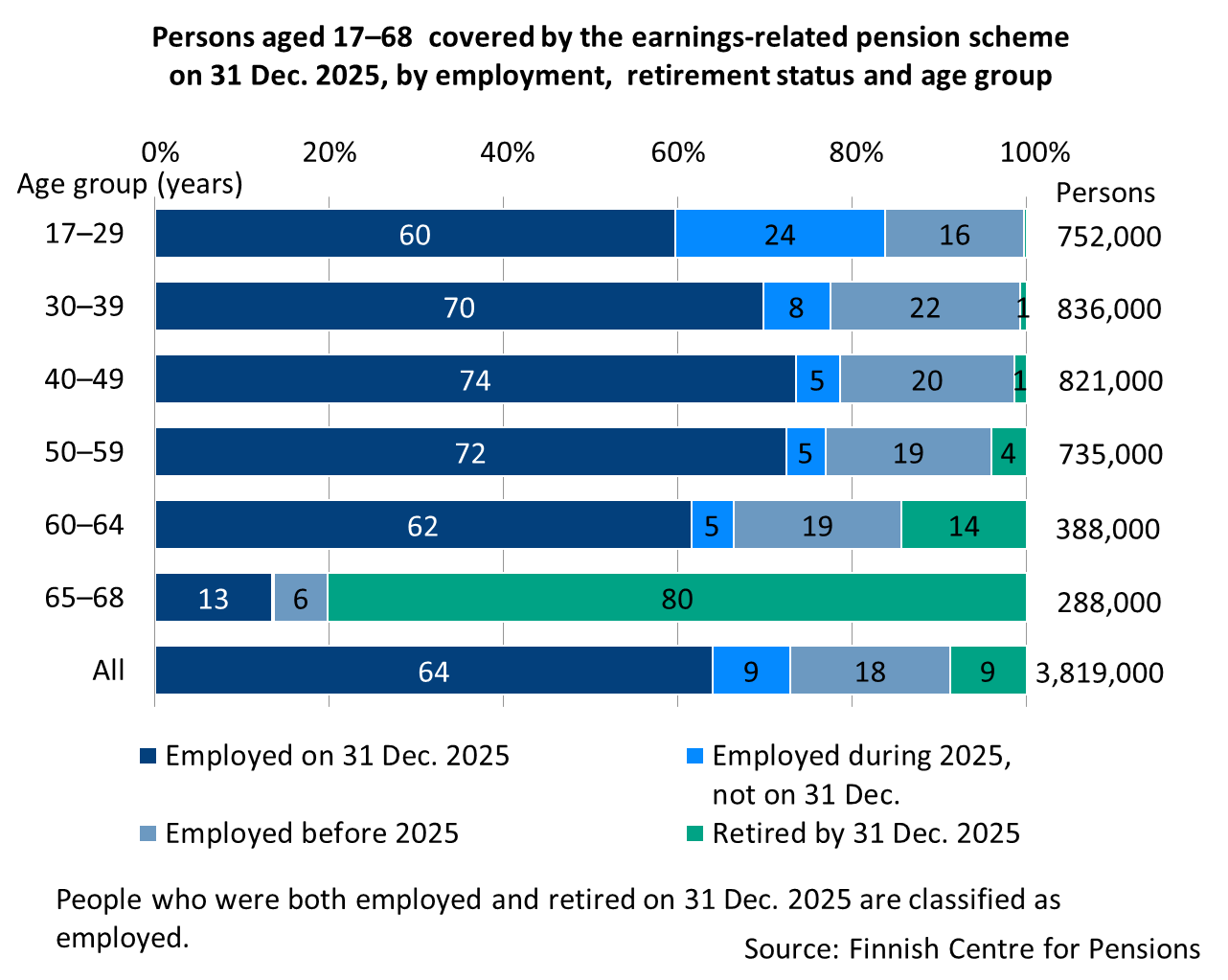
- At the end of the year, a total of 3.8 million people aged 17–68 were covered by the earnings-related pension scheme. Of these, 9 per cent were retired.
- A total of 2.8 million people accrued earnings-related pensions on the basis of their earnings and income from work in 2025.
- Wage earners’ median monthly earnings were 3,318 euros. Women’s median monthly earnings were 16 per cent lower than those of men.
- The median monthly insured income of self-employed persons covered by YEL was 1,542 euros. The monthly median insured income of those covered by MYEL was 2,025 euros.
- Almost one million people accrued earnings-related pensions during unsalaried periods. Unemployment benefits were paid to 580,000 people.
- A total of 85,000 people started work that insured them under the earnings-related pension scheme for the first time. The majority of these were young people just beginning their careers.
On this web page
- Persons covered by the earnings-related pension scheme
- First-time coverage under earnings-related pension acts
- Insured earnings and incomes
- Benefits registered for unsalaried periods
Persons covered by the earnings-related pension scheme
At the end of 2025, 3.8 million working-age people were covered by the earnings-related pension scheme. Of these, 2 million were men and 1.8 million were women.
Nearly two-thirds of the working-age population covered by the scheme were in employment at the end of the year, and 9 per cent had retired. Just over a quarter (27%) were neither employed nor receiving a pension at the end of the year but had previously accrued some pension. This group included students and unemployed persons. Two out of three of these had not been employed at all in 2025.
As the majority of Finland’s working-age population is covered by the earnings-related pension scheme, any fluctuations in their numbers result from demographic trends. Legislative changes and adjustments to age limits also affect these numbers. Under 10,000 people of working age die each year.
The number of working-age people covered by the earnings-related pension scheme has increased by more than 120,000 in the last decade. This rise may be partly because in 2017, the minimum age for mandatory insurance was reduced to 17.
Working-age people covered by the earnings-related pension scheme are aged 17–68 and have worked in jobs covered by the private or public sector pension acts, either as wage earners or as self-employed persons. This group also includes people of the same age who receive a pension on the basis of their employment history.
People in employment at the end of 2025
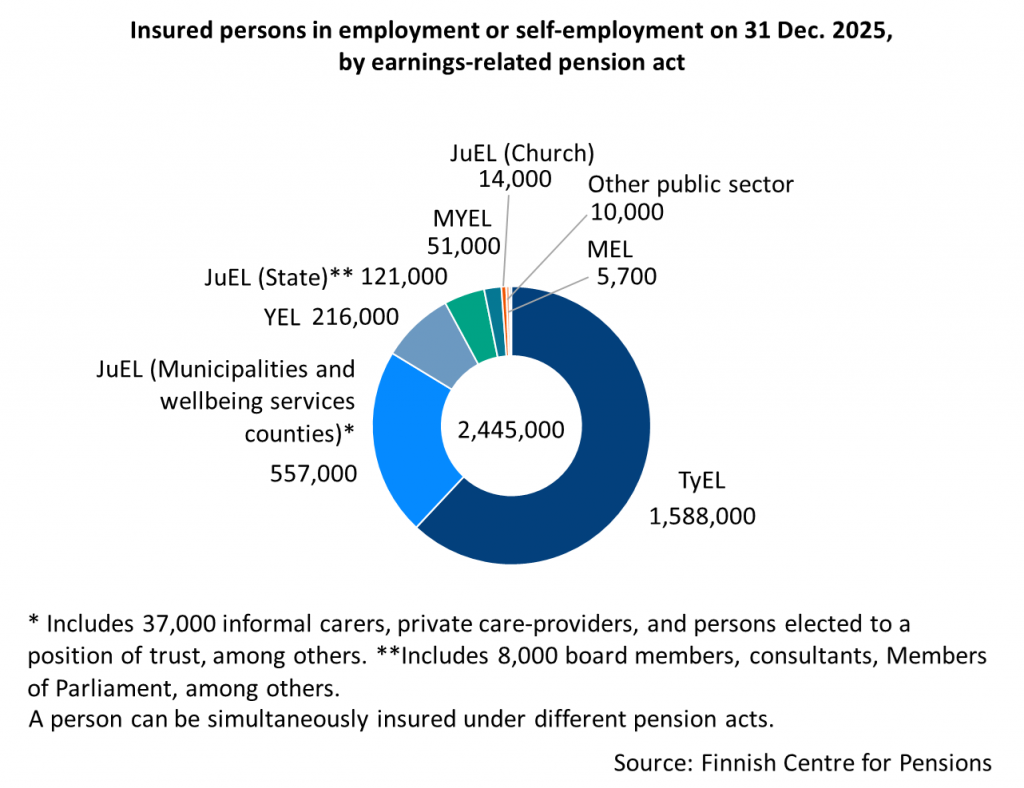
At the end of 2025, a total of 3.5 million people were insured for an earnings-related pension. Of these, 2.4 million (70%) were in active employment. Just over 1.8 million of these people worked in the private sector, and 690,000 in the public sector. A total of 71,000 people worked in both sectors simultaneously.
People in employment covered by earnings-related pension acts
Most wage earners worked in the private sector. At the end of 2025, almost 1.6 million were employed in work covered by TyEL. Within the public sector, 557,000 insured employees worked for municipalities and wellbeing services counties, and 121,000 worked for the state. A total of 216,000 people were insured under YEL. Those covered by MYEL numbered 51,000, and 4,900 (10%) of these were recipients of science and arts grants.
Trends in numbers of actively employed people, 2015–2025
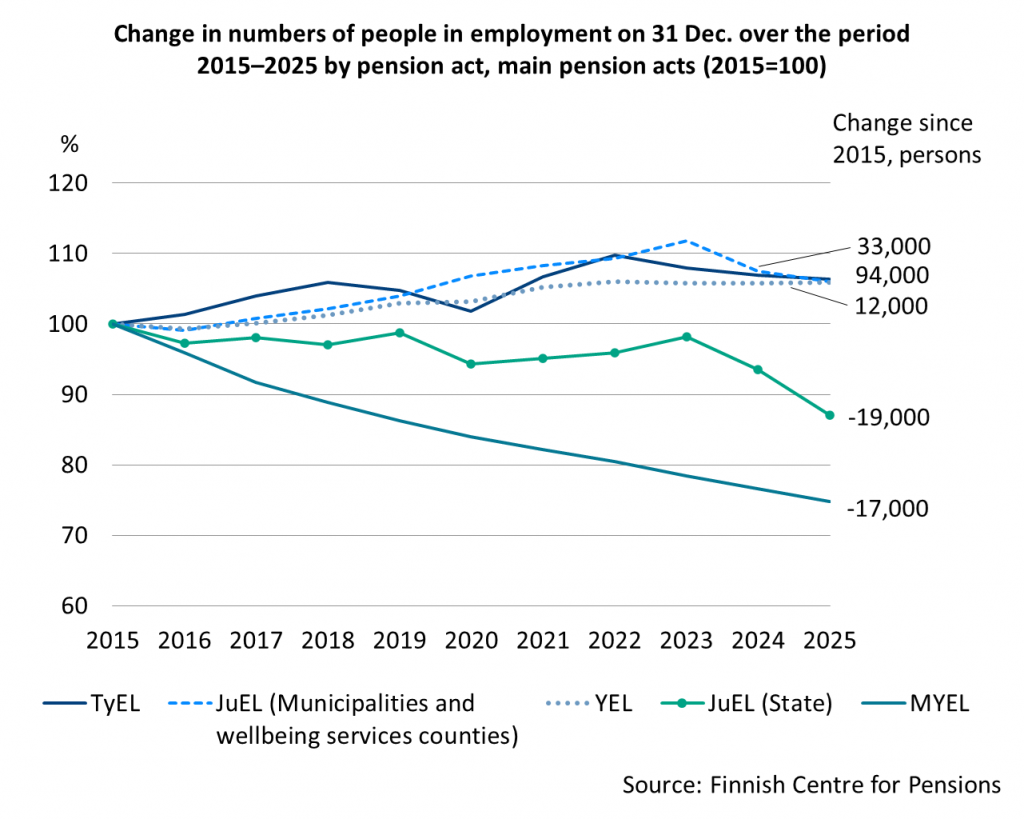
By the end of the year, the number of insured workers had risen by 5 per cent in the last decade. However, these trends varied depending on the earnings-related pension act. The number of agricultural entrepreneurs insured under MYEL has long been declining – in 2025, it was just over 50,000. In contrast, the number of other self-employed persons has remained at the current level of just under 220,000 for several years.
The number of state employees has clearly fallen over the last ten years due to the reorganisation of job roles. This decrease in 2025 can partly be explained by the fact that the responsibility for organising employment and economic development services was transferred from the state to the municipalities on 1 January 2025. As a result, 4,400 insured individuals were transferred from state employment to municipal services.
The labour market is heavily gender segregated In Finland. At the end of 2025, men accounted for 59 per cent of the workforce in the private sector, in comparison to 27 per cent in the public sector. Women were over-represented in the municipal sector and wellbeing services counties, where they made up 77 per cent of the workforce. The age distributions of people in active employment also vary depending on which earnings-related pension act they are covered by. Employees covered by TyEL are, on average, younger than self-employed persons and public-sector employees.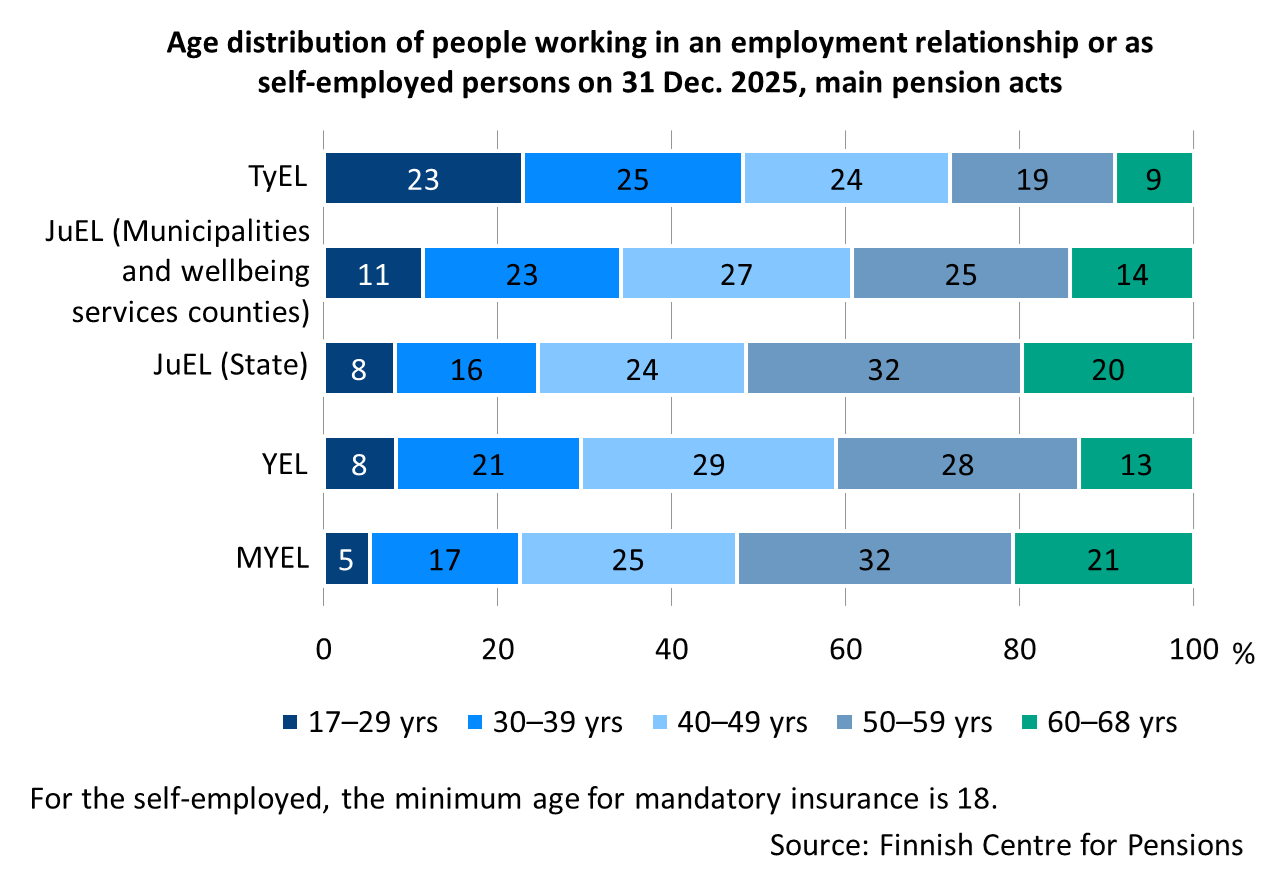
First-time coverage under earnings-related pension acts
First-time insured under the earnings-related pension scheme
In 2025, 85,000 people started work that insured them under the earnings-related pension scheme for the first time, which was well over 5,000 fewer than the previous year. Of these newly insured employees, 46,000 were men and 39,000 were women.
They were mainly young people, and some were immigrants. In 2025, just over half (56%) of the newly insured were under 20, and one-fifth (20%) were aged between 20 and 29.
A person’s first job covered by the earnings-related pension act is most commonly in the private sector. Of the newly insured, 86 per cent began work in the private sector and 14 per cent in the public sector. Of the men, 90 per cent began their careers in the private sector and 10 per cent in the public sector. Among the women, the corresponding percentages were 82 and 18 – women are more likely than men to begin their careers in the public sector.
First-time insured under the earnings-related pension scheme, by sector and gender
Economic situation and legislative changes affect number of newly insured persons
Approximately 100,000 new people enter the earnings-related pension scheme each year. This number is significantly influenced by the sizes of the new age groups entering the scheme and the number of immigrants, as well as by the economic situation and changes in legislation.
An exceptionally high number of employees entered the earnings-related pension scheme for the first time in 2017, when the minimum age for mandatory insurance was lowered to 17. However, in 2020, the year of the COVID-19 pandemic, the number of newly insured employees was exceptionally low, at 74,000. The last time it was this low was during the economic recession caused by the financial crisis in 2009.
In 2025, the number of newly insured persons – 85,000 – was 6 per cent lower than that of the previous year, which meant a decline for the third year running. In the private sector it fell by 6 per cent, and in the public sector by 7 per cent.
Newly insured persons covered by different earnings-related pension acts
In 2025, approximately 149,000 people began working under an earnings-related pension act for the first time. A total of 82,000 people began their first work covered by TyEL, and 37,000 people began their first work covered by JuEL in the municipalities and wellbeing services counties. Nearly 18,000 people became insured under YEL. Just under 7,000 newly insured employees joined the public sector.
The number of those newly insured under TyEL decreased by 6 per cent from the previous year. In the municipalities and the wellbeing services counties, this decline was 11 per cent, and in the state sector, 18 per cent. The number of people insured under YEL for the first time remained at the same level as the previous year.
In 2025, the newly insured under different earnings-related pension acts were
- persons who entered the earnings-related pension scheme for the first time
- persons who started their first work covered by a specific pension act, even if they had previously been covered by another pension act.
Insured earnings and incomes
In 2025, 2.8 million people accrued earnings-related pensions from their work-related earnings and incomes. Their average monthly work-related earnings and incomes that accrued a pension amounted to 3,569 euros. Their monthly median was 3,237 euros.
Of the insured, 2.6 million were wage earners, and 286,000 were self-employed persons insured under either YEL or MYEL, including recipients of science and arts grants. A person may be covered by several different earnings-related pension acts during the course of a year.
In 2025, the average monthly earnings of wage-earners covered by an earnings-related pension scheme amounted to 3,647 euros. The median monthly insured earnings were 3,318 euros. The income of self-employed persons (YEL and MYEL) that accrued pension was clearly lower: the average monthly insured income was 2,088 euros, and the median monthly insured income 1,631 euros.
Earnings subject to earnings-related pension insurance comprises all wages from work covered by earnings-related pension insurance, including earnings from causal, short-term or part-time work.
Insured earnings and incomes
Wage-earning women earned less than men on average
In 2025, wage earners’ average monthly insured earnings were 4,065 euros for men and 3,248 euros for women. Women’s average earnings were thus 817 euros lower than those of men – a difference of 20 per cent.
Men’s median monthly insured earnings amounted to 3,628 euros and women’s to 3,060 euros. Women’s median earnings were thus 568 euros – or 16 per cent – lower than those of men.
Wage earners’ insured earnings, by gender
The relative gender-based pay gap – in both average and median earnings – has narrowed slightly in recent years. Over the past five years, the relative gap in average earnings has narrowed by nearly three percentage points and the relative gap in median earnings by nearly four percentage points.
These differences in earnings are affected by the strong gender segregation in the labour market – women and men often work in different industries and occupations. Women work part-time more often than men, and it is also more common for women to take family leave than men, which affects their earnings growth.
Wage earners earn most in their fifties
On average, women’s insured earnings were lower than those of men in all age groups. Monthly insured earnings were lowest among young women just beginning their careers.
A closer look at median earnings by age group reveals that both men’s and women’s earnings rise when they are young, but that after the age of 30, the increase in earnings is slower among women than among men. At the same time, the gender pay gap continues to grow significantly. The pay gap also remains substantial in all older age groups.
Wage earners’ monthly insured earnings were at their highest when they were in their fifties. In 2025, the 45- to 49-year age group had the highest median earnings: men, 4,467 euros, and women, 3,682 euros. The highest average monthly earnings were among those aged 50–54: men 5,211 euros and women 4,054 euros.
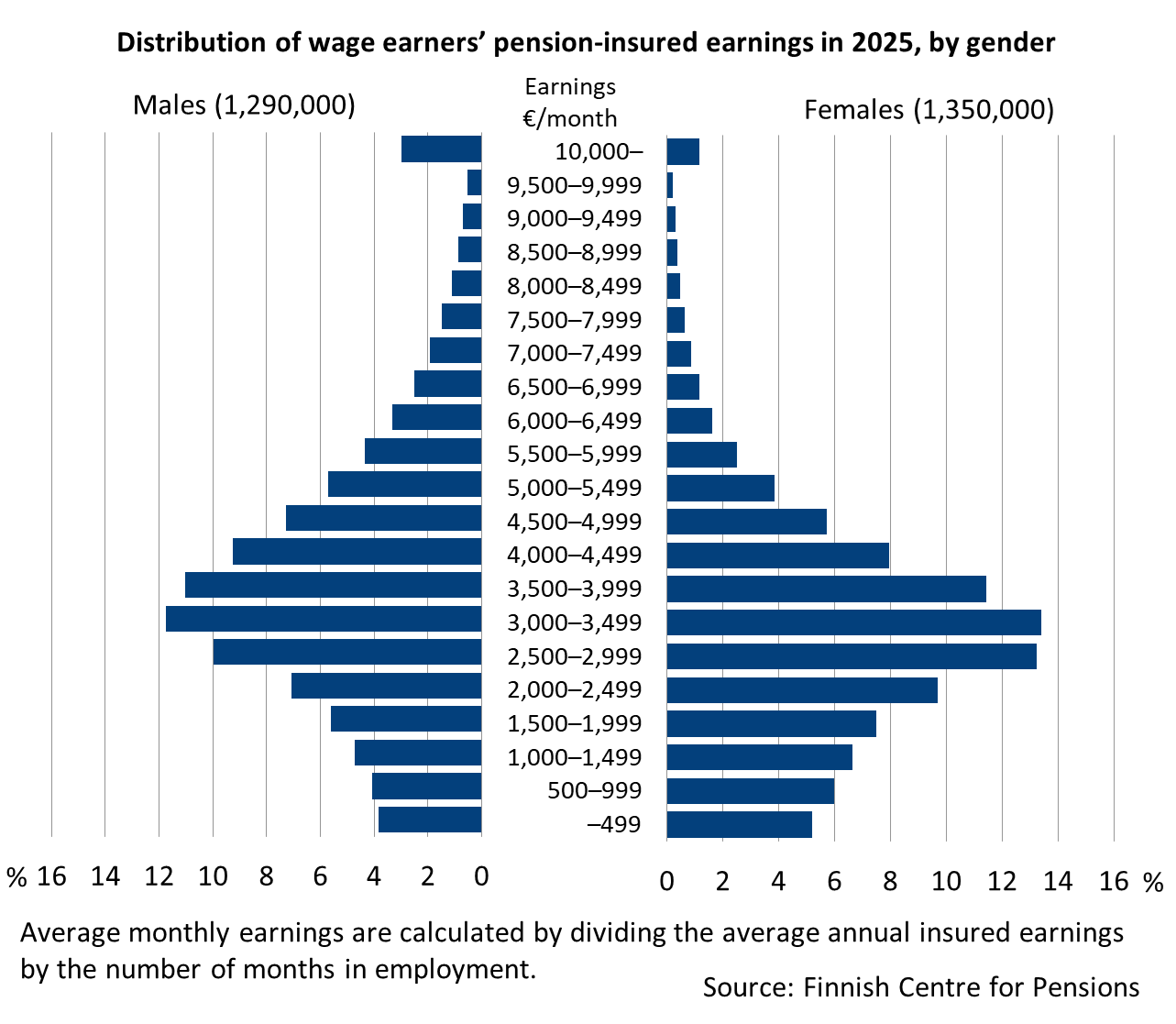
Wage levels of those insured under different pension acts varied
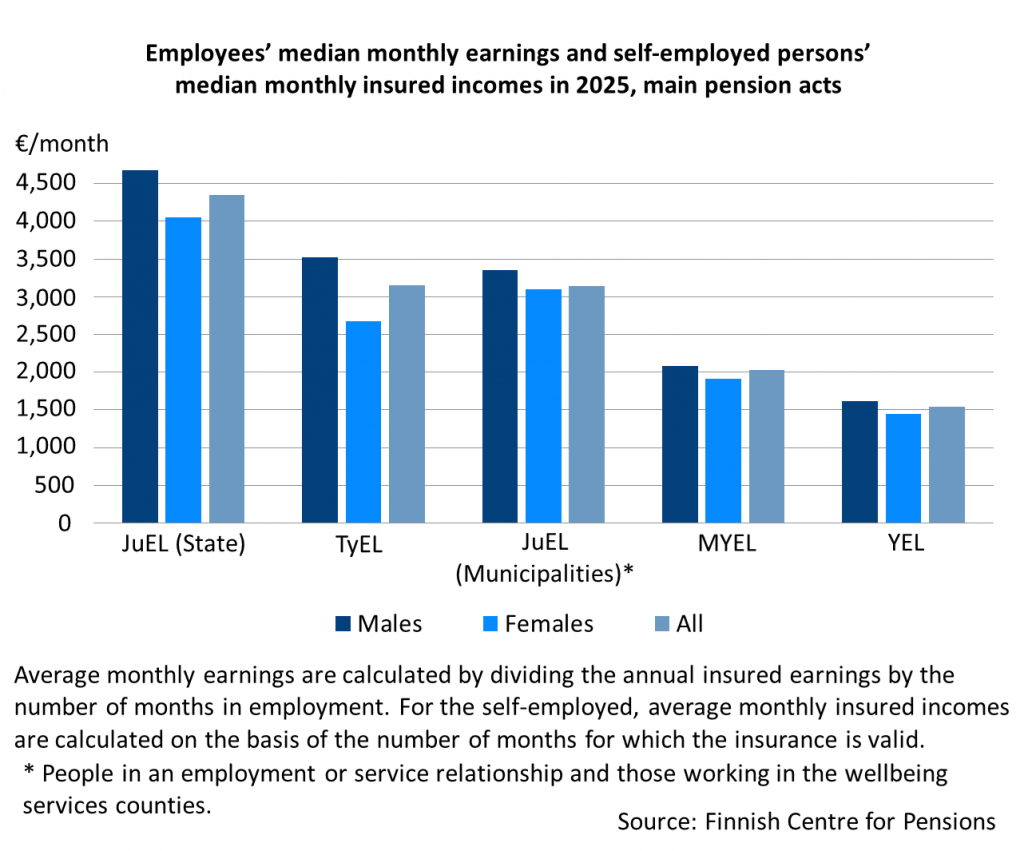
The average wage level is highest among those working for the state and the lowest among those working for the municipalities and wellbeing services counties. In 2025, the gender gap in insured earnings was the smallest in the municipalities and wellbeing services counties, where women’s median earnings were 257 euros (8%) lower than those of men. The gap was largest among those covered by TyEL: here, women’s median earnings were 851 euros (24%) lower than those of men.
The age and gender distributions of wage earners insured under different earnings-related pension acts vary. Those insured under TyEL are, on average, younger than public-sector wage earners. In the public sector, a clear majority of those working for the municipalities and wellbeing services counties are women, whereas more than half of TyEL-insured wage earners are men. Among those working for the state, women constitute a slight majority.
Wage earners' median insured earnings (euros/month), main pension acts
In 2025, the average earnings of all wage earners insured for an earnings-related pension rose by 3.0 per cent from the previous year, and the median earnings rose by 3.4 per cent. Women’s average earnings rose slightly more, in relative terms, than those of men.
Both the average and median earnings of private-sector wage earners rose by 3.1 per cent. In the public sector, the change was greater: average earnings rose by 3.6 per cent and median earnings by 4.9 per cent.
In the public sector – specifically in the municipalities and wellbeing services counties – the average earnings of employees and civil servants were 4.3 per cent higher than the previous year, and the median earnings were 5.6 per cent higher. Among those working for the state, the corresponding percentage increases in earnings were 5.0 and 5.5.
The main reason why the average earnings of wage earners in the municipalities and wellbeing services counties rose more than those of other employees is increases in the municipalities’ salary programme.
Median monthly YEL income just over 1,500 euros
In 2025, a total of 286,000 people accrued an employment pension from self-employment. This figure includes recipients of science and arts grants. Two-thirds of these self-employed persons were men. A total of 237,000 people were covered by YEL, and 56,000 agricultural entrepreneurs and grant recipients were insured under MYEL.
Their average monthly insured YEL income was 2,040 euros, and their monthly median was 1,542 euros. The average income of those insured under YEL rose by 1.9 per cent, and the median income rose by 3.2 per cent from the previous year.
The average monthly insured income of those covered by MYEL was on the same level as that of those covered by YEL: 2,044 euros. The monthly median MYEL-insured income was 2,025 euros. The average monthly insured income of those covered by MYEL rose by 2.1 per cent, and the median income rose by 3.2 per cent from the previous year.
On average, the insured income of self-employed women was slightly lower than that of self-employed men. The median monthly insured income of women covered by YEL was 166 euros (10%) lower than that of men. For those insured under MYEL, the difference was 162 euros (8%).
Average income of persons insured for an earnings-related pension, €/month
Median income of persons insured for an earnings-related pension, €/month
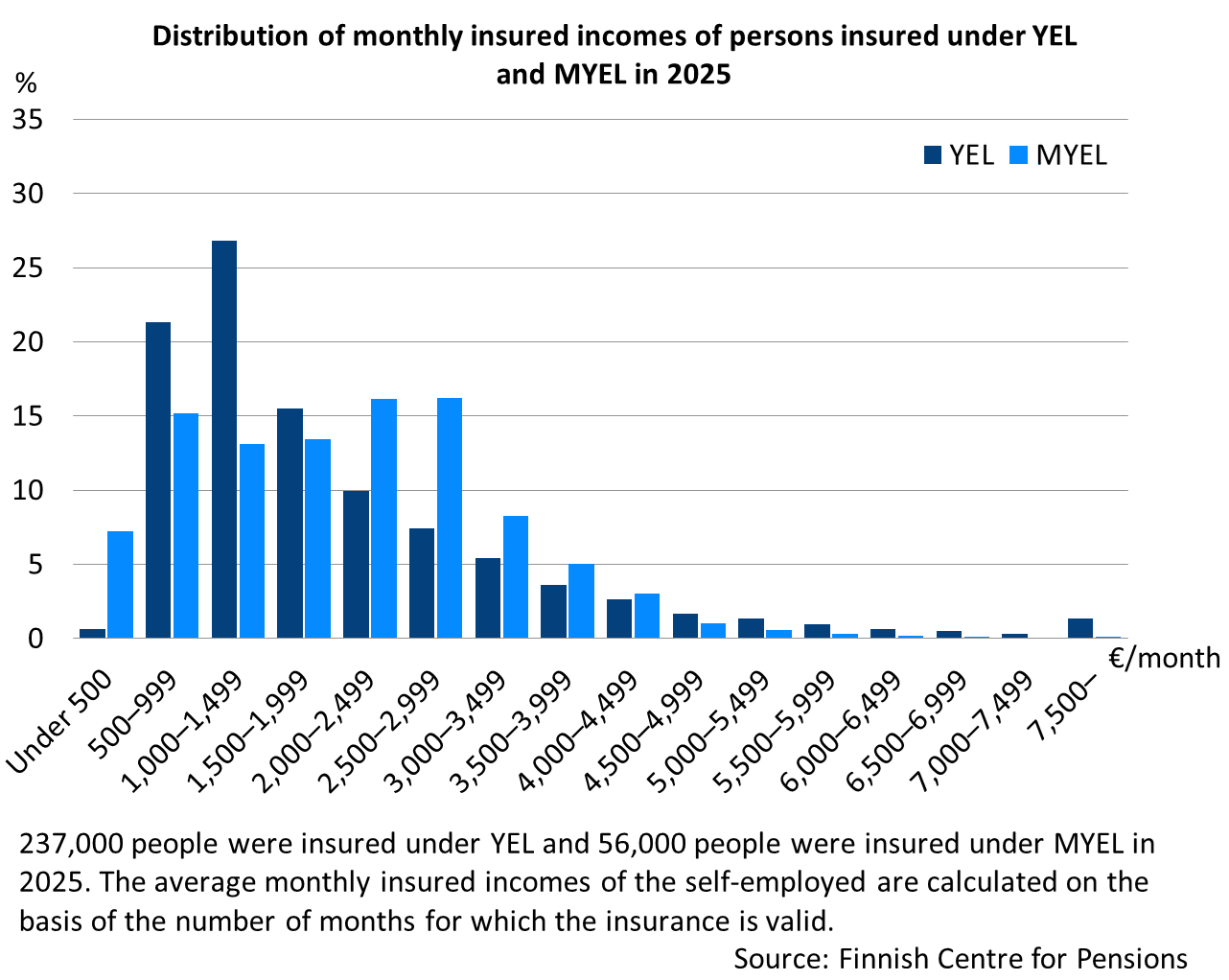
In 2025, 21 per cent of those insured under YEL had monthly insured incomes of 500–999 euros, and 27 per cent of those insured under YEL had monthly incomes of 1,000–1,499 euros. These income brackets include both the minimum YEL-insured income and the minimum employment requirement for unemployment insurance for the self-employed. Sixteen per cent had a monthly insured income ranging from 1,500 to 1,999 euros, and 10 per cent had a monthly insured income ranging from 2,000 to 2,499 euros.
Monthly insured incomes were more evenly distributed among those covered by MYEL than among those covered by YEL. Of these, 28 per cent had a monthly insured income of 500–1,499 euros, and 30 per cent had a monthly insured income of 1,500–2,499 euros. The income of 24 per cent of those insured under MYEL was 2,500–3,499 euros in 2025.
When converted into monthly sums, the minimum income level was 767.37 euros for those insured under YEL and 383.68 euros for those insured under MYEL, and the minimum employment requirement for unemployment insurance was 1,260.67 euros, based on 2025 levels.
Rise in confirmed YEL incomes
From 2023 to 2025, the earnings-related pension institutions reviewed the YEL incomes* of self-employed persons. These reviews found that confirmed incomes have risen significantly. This explains the decline in the number of self-employed persons with monthly insured incomes below 1,000 euros and the significant shift of self-employed persons into the 1,000–1,999- and 2,000–2,999-euro income brackets. The shifts between income brackets may also be explained to a small extent by the annual index adjustments to insured incomes.
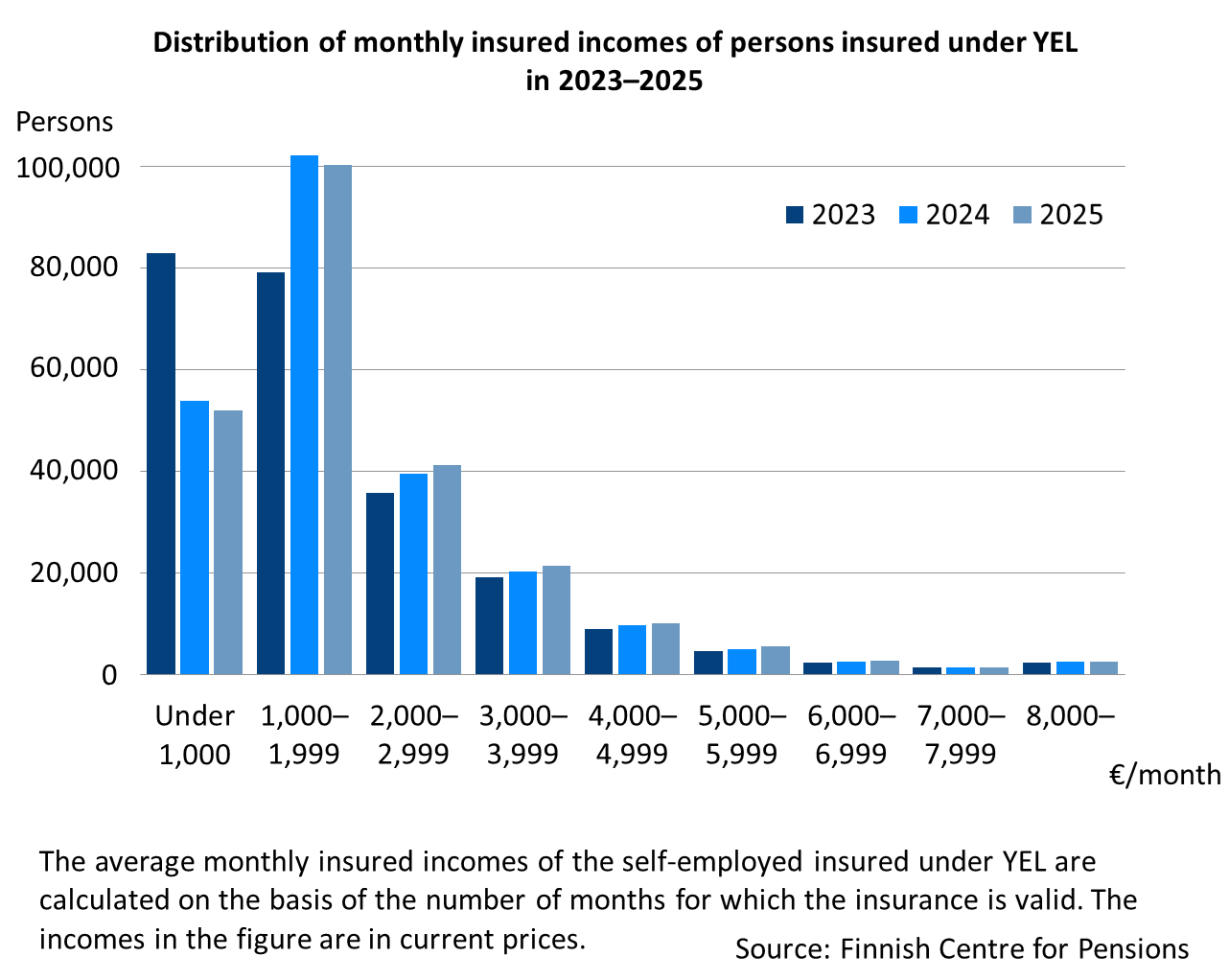
*In 2023, the earnings-related pension institutions reviewed all confirmed YEL incomes below 15,000 euros per year and those that had not undergone a substantive review in the last three years. This is equivalent to a monthly insured income of 1,250 euros. In 2024, YEL incomes below 25,000 euros per year – or below 2,083 euros per month – were reviewed. In 2025, the reviews mainly targeted incomes above these levels that had not been included in the euro-denominated reviews of the previous two years.
Benefits registered for unsalaried periods
In addition to earnings and income from work, earnings-related pension can also accrue during certain unsalaried periods such as periods of childcare, unemployment, illness and studies leading to a degree. To receive a pension that has accrued for unsalaried periods, an individual must also have accrued a pension from employment.
Pensionable earnings are either a specified proportion of the earnings on which the benefit is based or a fixed euro amount specified for the benefit in question.
Less people receiving sickness benefits
In 2025, approximately 970,000 people were registered as receiving benefits for unsalaried periods and VEKL* benefits, which was 2 per cent less than the previous year.
The clearly largest number of benefits were registered on the basis of unemployment – unemployment benefits were paid to nearly 580,000 people in 2025. The number of people who received a labour market subsidy rose, whereas the number of people who received earnings-related unemployment allowance fell from the previous year.
Just over 160,000 people received sickness benefits. The number of people who received daily sickness allowance decreased by 8 per cent from the previous year. Childcare benefits were paid to 180,000 people, and 120,000 people were registered as having completed their first degree. Fewer than 50,000 people were registered as receiving rehabilitation subsidies and motor liability and occupational accident insurance benefits. As adult education allowance and job alternation leave were abolished in 2024, only a small number of these benefits were paid in 2025.
Of those who accrued earnings-related pensions during unsalaried periods, slightly more than half (51%) were women. Most motor liability and occupational accident insurance benefit recipients were men. The share of men receiving unemployment benefits was also somewhat higher. In the case of all other benefits, most recipients were women.
Benefits for unsalaried periods alone do not entitle an individual to accrue a pension; they must also have worked in employment that has accrued a pension. In 2025, just over 150,000 people (16%) who received benefits for unsalaried periods were not yet covered by the earnings-related pension scheme, and had thus not accrued enough pension from employment to entitle them to pension accrual during unsalaried periods.
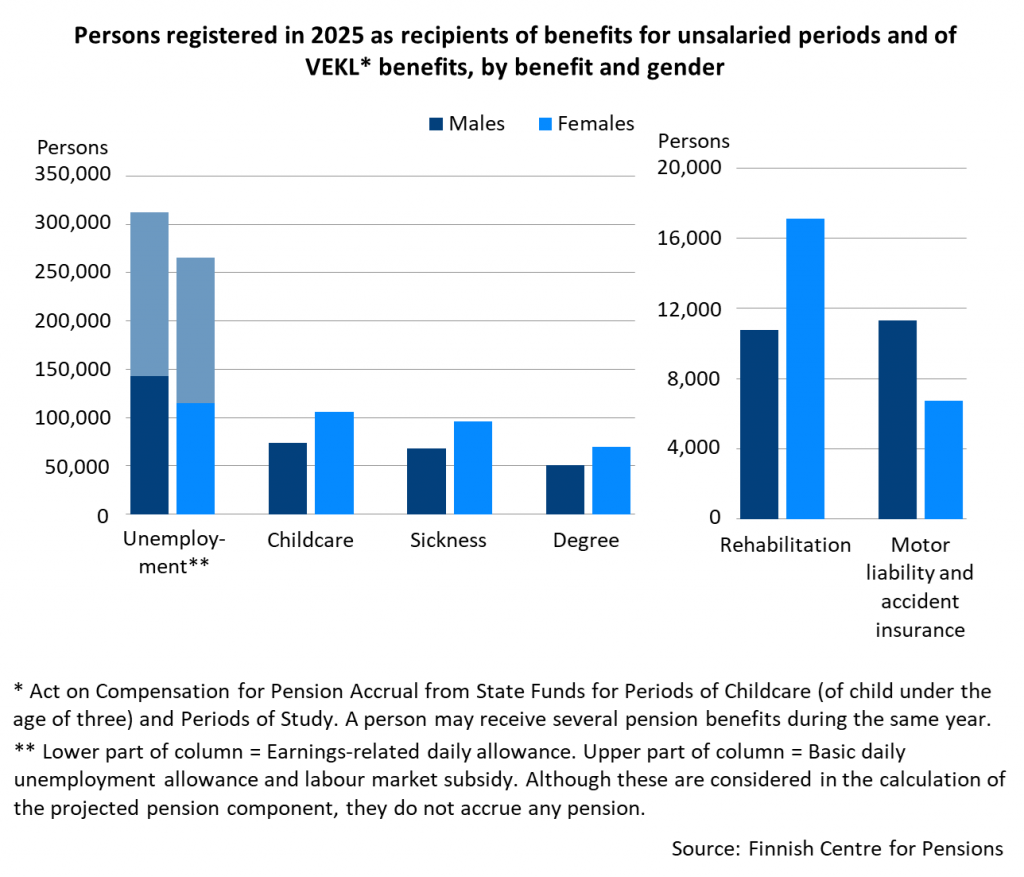
* Act on Compensation for Pension Accrual from State Funds for Periods of Childcare (of child under the age of three) and Periods of Study.
(Updated on 5 Nov 2026)
Persons aged 17–68 covered by the earnings-related pension system
- Total earnings-related pension system by age group
- Total earnings-related pension system, Time Series
- Private sector, Time Series
- Public sector, Time Series
Employed or self-employed at year-end
- By age and gender on 31 December
- By age, earnings-related pension sector and gender on 31 December
- By earnings-related pension act and gender on 31 December
- By earnings-related pension sector 31 December, Time Series
Persons covered by the earnings-related pension scheme for the first time
Persons covered by various earnings-related pension acts for the first time
Earnings and incomes insured for earnings-related pension, €/month
- Average earnings or incomes by earnings-related pension act and gender
- Average and median earnings of employees by age and gender
- Average incomes of persons insured under the Self-employed Persons’ Pensions Act and the Farmers’ Pensions Act by age and gender
- Median incomes of persons insured under the Self-employed Persons’ Pensions Act and the Farmers’ Pensions Act by age and gender
- Number of persons, average and median earnings, by gender
Distribution of earnings and incomes of persons insured for an earnings-related pension, €/month
Read more on Etk.fi:
Statistical tables in statistical database:
Tables and graphs in Key Figures:
Our experts in this area:
- Jari Kannisto
firstname.surname@etk.fi - Marjo Kaasila
firstname.surname@etk.fi
Statistical services provides further information:
Data on earlier statistical years are in our statistical database:
News and press releases:
- News 5 Nov 2026: Women’s median earnings remain 16% below men’s despite a slight narrowing of the gap in recent years
- Press release 20 Nov 2025: Wages on the rise – young people face increasing barriers to entering the labour market
- Press release 28 Nov 2024: Employees’ earnings rose by more than 4 per cent in 2023
- Press release 14 Dec 2023: Pension-insured earnings of employees more than twice as high as the insured incomes of the self-employed
- News 30 Nov 2022: Young people’s access to the labour market normalised in the second year of the corona
- Press release 30 Nov 2021: The corona pandemic made it more difficult for young people to enter the labour market
- Press release 11 Dec 2020: Women’s income development slows markedly at family formation age
Previous releases in the shared open repository Julkari:
Statistical publications in the shared open repository Julkari:
Producer: Finnish Centre for Pensions
Website: Persons insured for an earnings-related pension in Finland
Subject area: Social security
Part of the Official Statistics of Finland (OSF): Yes
Description
The statistics describe persons insured under the Finnish earnings-related pension scheme, employees’ insured earnings and self-employed persons’ insured incomes.
Data content
The statistics contain key numerical data on all persons aged 17–68 insured under the Finnish earnings-related pension scheme and on persons who have retired. In addition, the statistics provide information on employees’ insured earnings, self-employed persons’ insured incomes and pension accrued on the basis of benefits received during unpaid periods and under the Act on Compensation for Pension Accrual from State Funds for Periods of Caring for a Child Aged under Three and Periods of Study.
Categorizations
Private and public sector, earnings-related pension act, gender and age.
Methods of data collection and source
The statistics are based on data drawn from earnings and pension registers under the earnings-related pension scheme.
Update frequency
Once a year.
Time of completion or release
The statistics are released at the end of the year following the statistical year. For a more detailed schedule, consult the Release Calendar.
Time series
The statistics have been compiled since 2005. Time series for the private sector go back to 1977. The data are in the main comparable from 2007 onwards. The statistics on insured incomes for the self-employed have been produced for the statistics on Persons Insured for an Earnings-related Pension in Finland as of the beginning of 2022.
Key words
insurance, social insurance, pensions, earnings-related pensions, employment relationship, employees, wages, self-employed, insured income
Contact information
Concepts relating to working
Covered by the earnings-related pension scheme
Persons covered by the earnings-related pension scheme refer to those who have been employed or self-employed during the statistical year or earlier. In other words, the earnings-related pension scheme covers those persons who are entitled to an earnings-related pension at the time of the pension contingency or who already receive a pension based on their employment history.
Earnings-related pension act
Persons are classified as covered by all earnings-related pension acts under which they have been insured during their employment history.
Earnings-related pension sector
Persons are classified into pension sectors based on the earnings-related pension acts applicable during their employment history. If they have been employed in both the private and public sector, they will be included in the figures for both sectors.
Employed at the end of the statistical year
A person employed at the end of the year is someone who has been employed in December (employment relationships based on a monthly notification) or whose employment relationship has ended or been in force at the end of the year (employment relationships based on an annual notification). Pension recipients who are in employment or self-employment while drawing a pension are classified as being employed.
Employed or self-employed
An employed person is someone who during the statistical period has been in employment that accrues earnings-related pension, or who has been insured for earnings-related pension under the Self-Employed Persons’ Pensions Act or the Farmers’ Pensions Act.
Employee
An employee is a person who has engaged in work that is covered by earnings-related pension acts, excluding the Self-Employed Persons’ Pensions Act (YEL) or the Farmers’ Pensions Act (MYEL). In practice, this means all employees excluding self-employed persons, farmers and recipients of science and arts grants. In these statistics, employees also include special groups covered by JuEL (municipal), such as persons elected to a position of trust and family carers. Private caretakers who have signed a commission agreement although they are not in an employment relationship with a municipality or a municipal federation as referred to in the Contracts of Employment Act are also considered employees.
Not employed during the statistical year
A person who is not employed during the statistical year is someone who has not engaged in employment that accrues earnings-related pension or who has not been insured for an earnings-related pension based on the Self-Employed Persons’ Pensions Act or the Farmers’ Pensions Act. In addition, it is required that this person has been insured for an earnings-related pension before the statistical year or that this person receives a pension based on their employment history.
Pension recipient
A pension recipient is a person who receives an earnings-related pension based on their employment history. A pension recipient may receive an old-age, disability or part-time pension or a farmer’s special pension. Some pension recipients additionally receive pension benefits paid out by Kela; these benefits are not considered in these statistics.
Person covered by the earnings-related pension scheme for the first time
A person is covered by the earnings-related pension system for the first time when they enter into their first employment relationship or period of self-employment that must be insured under earnings-related pension legislation. This first employment relationship determines the sector used in the statistics.
Person covered by various earnings-related pension acts for the first time
A person is covered by an earnings-related pension act when they enter into their first employment relationship or a period of self-employment that must be insured under the earnings-related pension act in question. For example, if a person has entered into their first employment relationship that is to be covered by the Employees Pensions Act (TyEL) and their first relationship that is to be covered by the Local Government Pensions Act (KuEL) in one and the same year, the person is recorded in the statistics for both acts.
Persons insured for earnings-related pension benefits
Persons insured for earnings-related pension benefits are those who during the statistical year or earlier have been employed or self-employed and who at the time of the pension contingency are entitled to an earnings-related pension. Typically, a person insured for earnings-related pension benefits has not yet retired, but even a retiree may be insured if they have been working while in retirement under age 68.
Self-employed person
A self-employed person is a person who is covered by the Self-employed Persons’ Pensions Act and has or has had valid insurance under the Self-employed Persons’ Pensions Act or the Farmers’ Pensions Act in the statistical year or earlier. Farmers and recipients of science and arts grants are covered by the Farmers’ Pensions Act.
Working during the statistical year
Persons are considered to have worked during the statistical year if, during that time, they have engaged in employment that accrues earnings-related pension or if they have been insured for an earnings-related pension under the Self-Employed Persons’ Pensions Act or the Farmer’s Pensions Act.
Concepts relating to earnings
Annual and monthly earnings
In these statistics, the earnings for employees are the earnings insured for an earnings-related pension, and for self-employed persons, their insured incomes. For employees, the annual earnings are calculated by adding up the monthly insured earnings received during a calendar year. For the self-employed, the annual earnings are the actual insured incomes relative to the period of validity of the insurance while the monthly earnings are calculated by the number of months during which the insurance is valid.
- Example. An employee was in employment from 20 August to 10 September, with insured earnings of 2,000 euros. In this case the monthly earnings entered in the statistics were 2,000 euros/2 = 1,000 euros/month, because the employment spell stretched across two different months. If the employment spell had taken place during one month (e.g. from 2 to 22 September), then the monthly earnings would have been 2,000 euros. If this was the employee’s only spell of employment during the calendar year, the annual earnings entered in the statistics would in both cases have been the same, i.e. 2,000 euros.
Benefits accrued from unpaid periods and under VEKL
Unpaid periods are periods during which a person receives a social benefit that may, under certain conditions, affect pension accrual. Unpaid periods include periods on a parental, sickness or unemployment allowance. The grounds on which various unpaid periods impact on the final amount of earnings-related pension are set out in earnings-related pension acts.
Benefits accrued on the basis of child home care allowance and the completion of degrees and qualifications are funded by the State. These benefits are based on the Act on Compensation for Pension Accrual from State Funds for Periods of Childcare and Periods of Study (VEKL).
The benefits received for unpaid periods and based on VEKL are recorded in the earnings-related pension scheme’s earnings register. Benefits for unpaid periods are also recorded for persons who have no employment history and who therefore are not covered by the earnings-related pension scheme.
It is noteworthy that it is possible during unpaid periods to undertake work that is insured for an earnings-related pension and that counts towards the person’s pension accrual.
Employees’ insured earnings
For employees, insured income (or shorter, insured earnings or earnings) consists of items of income for which earnings-related pension accrues. The main part of earnings is the wage, performance bonus or other compensation paid for work done. The most significant other compensation includes various fringe benefits and holiday remunerations, including compensation paid when the employment relationship ends (e.g., compensation for untaken saved holidays). As a rule, no pension accrues for daily allowances and share option arrangements, and these compensations are not included in the insured incomes. In these statistics, insured incomes also include the pension contributions paid by employees even when no pension accrued for these payments before 2017.
Self-employed person’s insured incomes
These statistics review the insured incomes of self-employed persons insured under the Self-employed Persons’ Pensions Act (YEL), considering any supplementary or reduced earnings-related pension contributions paid (YEL Chapter 67). For those insured under the Farmers’ Pensions Act (MYEL), this means their confirmed income.
Upper and lower limit of incomes
The confirmed monthly income of a self-employed person must be at least 9,208.43 euros (under the Self-employed Persons’ Pensions Act) or 4,604.21 euros (under the Farmers’ Pensions Act) at 2025 level. The upper limit of the confirmed annual income for a self-employed person under the Self-employed Persons’ Pensions Act is 209,125.00 euros at 2025 level. The limits change annually in line with the change in the wage coefficient.
Other concepts
Age
Person’s age at the end of the statistical year.
Decile
Deciles are used to divide employees into ten equally large earnings groups. Decile boundaries indicate the level of earnings beneath which lie 10%, 20%, … , 90% of all cases.
Median
When all employees are rank-ordered according to earnings, median earnings are the mid-point of the earnings distribution. There are exactly the same number of employees above the median as below the median. The median is less sensitive to outliers than the average. Especially in skewed distributions such as those of earnings, the median gives a better representation of central tendency than average.
Earnings-related pension acts
Private sector
- TyEL Employees Pensions Act
- MEL Seafarer’s Pensions Act
- YEL Self-employed Persons’ Pensions Act
- MYEL Farmers’ Pensions Act
Public sector
- JuEL The Public Sector Pensions Act came into force at the beginning of 2017. It combined the previously valid public sector pension acts such as the Local Government Pensions Act, the State Employee’s Pensions Act, the Evangelical-Lutheran Church Pensions Act and the special act for Kela employees. Pensions for the employees of the Bank of Finland have been regulated under the Public Sector Pensions Act since the beginning of 2021. As of the beginning of 2023, also the wellbeing services counties are covered by the Public Sector Pensions Act.
- Pension regulation for the regional government of Åland
1. Contact
1.1 Contact organisation
The Finnish Centre for Pensions
1.2 Contact organisation unit
Planning Department
1.3 Contact name
1.4 Contact person function
Statistical expert
1.5 Contact mail address
The Finnish Centre for Pensions
FI-00065 ELÄKETURVAKESKUS
Finland
1.6 Contact email address
firstname.lastname@etk.fi
Contact form
1.7 Contact phone number
+358 29 411 20
1.8 Contact fax number
Fax: +358 9 148 1172
2. Metadata update
2.1. Metadata last certified
5 Nov 2026
2.2. Metadata last posted
5 Nov 2026
2.3. Metadata last update
5 Nov 2026
3. Statistical presentation
3.1. Data description
In Finland, work done by individuals aged 17–68 is subject to earnings-related pension insurance. The statistics provide an overview of the employment and retirement situations of individuals aged 17–68 who are covered by the earnings-related pension system, as well as the earnings and income that contribute to their earnings-related pensions. The statistics also include information on individuals who have received social benefits that affect the amount of their earnings-related pension.
3.2. Classification system
Persons covered by the earnings-related pension system are divided into those insured for earnings-related pensions and those who are retired. The number of persons insured for earnings-related pensions is classified into two groups: those who were employed at the time of the statistics and those who were not employed nor retired at the time of the statistics. Other classifiers used include the earnings-related pension sector and act, as well as the person’s age and gender.
Average and median earnings and incomes data for those insured for earnings-related pensions are presented, classified by earnings-related pension sector and act, as well as by gender and age. The distribution of earnings is detailed by gender and age group.
The number of persons who have received benefits that accrue earnings-related pensions during unsalaried periods is presented, classified by type of benefit.
3.3. Sector coverage
The statistics are based on comprehensive data, so they include all individuals aged 17–68 covered by the earnings-related pension system.
3.4. Statistical concepts and definitions
The concepts and definitions have been presented on the statistics page.
3.5. Statistical unit
Person covered by the earnings-related pension system.
Earnings and incomes for which earnings-related pensions have accrued.
3.6. Statistical population
Persons covered by the Finnish earnings-related pension system.
3.7. Reference area
Finland
3.8. Time coverage
The basic data of the statistics are available from 2005 onwards. For the private sector, the time series starts from 1977. The earnings-related pension-insured earnings data for employees have been produced in the statistics since 2015, and the insured incomes for the self-employed has been included since 2022.
4. Unit of measure
Number of persons.
Earnings and incomes: €/month and €/year (gross amounts).
5. Reference period
Calendar year and 31 December
6. Institutional mandate
6.1. Legal acts and other agreements
The Act on the Finnish Centre for Pensions states that the Finnish Centre for Pensions is responsible for statistical activities within its field of competence.
6.2. Data sharing
Part of the data is delivered to Statistics Finland for the statistics Employment.
7. Confidentiality
7.1. Confidentiality – policy
The Finnish Centre for Pensions is committed to data protection as a fundamental principle of statistics, which ensures the confidentiality of data.
7.2. Confidentiality – data treatment
Data is protected by the necessary physical and technical solutions at the various stages of processing. Employees have access only to the data necessary for their work. Third parties do not have access to the premises where the data is processed. Employees are required to sign a confidentiality agreement when they are hired.
8. Release Policy
The statistics of the Finnish Centre for Pensions are released on weekdays at 9.00 a.m. on the website of the Finnish Centre for Pensions. Any exceptions to the release time are announced separately.
The data in the statistical database are released as open data. The database’s open interface can be freely used under the CC BY 4.0 license, with the Finnich Centre for Pensions being cited as the source of the statistical data.
8.1. Release Calendar
The release dates of the statistics are published in the release calendar. The release calendar for the following year is published towards the end of the year.
8.2. Release calendar access
8.3. User access
The statistics are available to everyone when they are published on the website of the Finnish Centre for Pensions at a previously announced date.
Embargo policy: Media that are bound by the journalist’s guidelines may request material from the Finnish Centre for Pensions’ Communications Department.
9. Frequency of dissemination
The statistics are published once a year.
10. Accessibility and clarity
10.1. News release
The releases of the statistics can be found in the shared open repository Julkari: Persons Insured for an Earnings-related Pension in Finland (Julkari).
Press releases on this topic can be found online at the website of the statistics.
10.2. Publications
Persons insured for an earnings-related pension in Finland (Julkari)
Persons insured for an earnings-related pension in Finland, 2013–2020 (Julkari)
Pensioners and insured in Finland, 2005–2013 (Julkari)
10.3. Online database
Persons insured for earnings-related pension (PxWeb)
10.4. Microdata access
The Finnish Centre for Pensions’ registry data can be requested for scientific research use.
Pension register data and Earnings and Accrual Register data on employment covered by earnings-related pension insurance can be used for research purposes in accordance with the Publicity Act, Data Protection Act, and the Act on the Secondary Use of Health and Social Data (hereinafter Act on Secondary Use), even though individual-level data is confidential. The research must be individualized and scientific and based on a research plan. Register data are not disclosed for commercial purposes.
Apply for research access to register data of the Finnish Centre for Pensions
11. Quality Management
11.1. Quality assurance
The Finnish Centre for Pensions is committed to the quality principles of Official Statistics of Finland. Our statistical production follows the quality criteria of Official Statistics of Finland, which are compatible with the European Statistics Code of Practice.
11.2. Quality assessment
The quality of statistics is assessed at several stages in the statistical process.
12. Relevance
12.1. User needs
Feedback from users is gathered through customer surveys. Feedback is also collected through direct contact. The feedback received is monitored and taken into account in the development of the statistics.
13. Accuracy and reliability
13.1. Overall accuracy
The data is based on administrative registers. The initial data is at the individual level, and it determines the amount of the insured person’s annually accrued earnings-related pension and the final earnings-related pension.
13.2. Sampling error
–
13.3. Non-sampling error
The data is based on register extracts made at a specific point in time, so the statistics reflect the situation at the time of extraction. The registers are continuously updated, and retrospective changes are also made to them.
14. Timeliness and punctuality
14.1. Timeliness
The statistics are published towards the end of the year following the statistical year.
15. Coherence and comparability
15.1. Comparability – geographical
–
15.2. Comparability – over time
The statistics has been produced since 2005. The data in the statistics are broadly comparable between different years from 2007 onwards. There may be small differences in the figures due to corrections and changes made to the statistical software.
The comparability of time series is affected by the following changes:
Due to the 2017 pension reform, the lower age limit for mandatory insurance for employees was lowered to 17 years. This increased the number of young people insured for earnings-related pensions.
The 2017 pension reform raised the retirement age by three-months increments for each cohort starting from those born in 1955. For those born in 1962, the retirement age is 65 years, whereas for those born in 1954, it was 63 years. This change has a significant impact on the number of people aged 63 who are still working.
As the retirement age rises, the age when the insurance obligation ends also rises. For those born between 1958 and 1961, the insurance obligation ends at age 69, and for those born in 1962, at age 70. This change raises the insured populations’ age at when the insurance obligation ends and thus expands the number of age groups examined in the statistics.
Starting from the 2019 data, the earnings information of employees stored in the earnings-related pension system’s register is based on the Incomes Register maintained by the Tax Administration. With the introduction of the Incomes Register, the number of months that wages have been paid over the year has become more specific. Previously, the reported earnings-related pension-insured earnings and periods of work for an employee’s employment relationship were reported once a year and may have included unsalaried periods. Since the Incomes Register only includes months in which wages were paid, monthly earnings are more accurately allocated to the months with wage payments.
The change in the data basis increased the monthly earnings of the public sector and especially the municipal sector under the Public Sector Pensions Act (JuEL), making the change compared to monthly earnings before 2019 appear larger than it is. However, the impact is small when comparing all employees and private sector employees. The change does not affect the comparison of annual earnings.
Additionally, because of the introduction of the Incomes Register, some tables describing the situation at the end of the year in the statistics show a slight shift from the group “employed” to the group “not employed, not retired,” especially in the private sector. This change may complicate comparisons with statistical years before 2019.
In 2020, the statistical history of benefit information for unsalaried periods up to 2019 was updated according to the register situation in August 2020, as some of the benefit information for unsalaried periods had been retrospectively corrected.
From the 2022 data onwards, the definition of those in the municipal sector under JuEL who are not in an employment relationship or who work as civil servants (including family caregivers, private caregivers, trustees, etc.) has been changed. Persons without registered income from this activity have been removed from the statistics.
From the 2022 data onwards, the statistics on employees’ earnings include all those covered by the municipal sector insurance under JuEL. Before 2022, the earnings statistics for insured persons in the municipal sector under JuEL only included those in employment or who worked as civil servants.
15.3. Coherence – cross domain
Differences in the definitions of concepts and the data basis make it difficult to compare with other statistics in the same statistical area.
16. Cost and burden
The production of the statistics is financed annually by the Finnish Centre for Pensions.
17. Data Revision
–
18. Statistical processing
18.1. Source data
The statistics are based on the registers of the Finnish Centre for Pensions.
18.2. Frequency of data collection
–
18.3. Data collection
Administrative registers.
18.4. Data validation
Adjustments are made at different stages of statistical production in accordance with the production processes of the Finnish Centre for Pensions. In addition, the results are compared with changes in legislation and with data from previous statistical years.
18.5. Data compilation
The data is extracted from the registers of the Finnish Centre for Pensions. Further processing produces aggregated data and statistical tables.