Number of working pensioners starts to fall

After years of growth, the number of people working while drawing a pension has begun to fall. The decline reflects the rise in the minimum retirement age.
Until recently, the number of working pensioners in Finland has been rising steadily. Statistics from the Finnish Centre for Pensions show that the number of working pensioners under 68 levelled off and then declined slightly during 2023–2025.
The change is explained both by the rise in the minimum retirement age and the prolonged economic downturn, which has also reduced job opportunities for pensioners.
“As people start drawing their old-age pension later, there are naturally fewer younger pensioners. There are also fewer pensioners below the upper age limit for compulsory pension insurance,” says Development Manager Jari Kannisto from the Finnish Centre for Pensions.
The minimum retirement age has now risen by 18 months, while the age at which the insurance obligation ends remains unchanged. The age at which the insurance obligation ends will first rise for those born in 1958, who turn 69 next year.
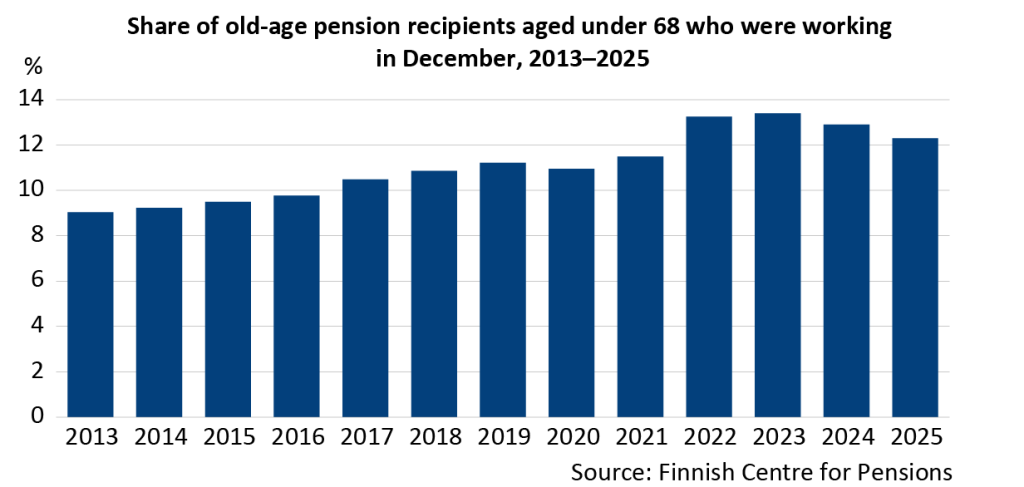
At the end of 2025, 1.5 million people in Finland were receiving an earnings-related pension. One in ten of them was working. Among old-age pensioners under 68, the proportion in work was slightly higher, at around 12 per cent.
Pensioners often work part-time or on a temporary basis. The statistics therefore show both the number working in December and the number who worked at any point during the year. These figures differ considerably.
Working in retirement boosts employment rates among older age groups
Working pensioners continue to make a substantial contribution to employment rates among older age groups. For example, in 2025, more than half of those aged 65–69 who were in work were also drawing a pension.
Nearly one in ten people aged 60–64 who were in work in 2025 was also drawing a pension. Within this age group, the proportion was highest among 64-year-olds.
Nearly 40,000 disability pension recipients worked at some point during 2025, and 25,500 were in work in December. Among those receiving a partial disability pension, work was the rule rather than the exception: four in five were in work at the end of the year.
Working can double pensioners’ monthly income
In 2025, men who worked while drawing an old-age pension had an average total monthly income from earnings and pensions of nearly €4,900 before tax. For women, the figure was just under €3,400. Working old-age pensioners received an average monthly pension of €2,170, which is €200 more than did those who were not working.
Kannisto says these are substantial sums.
“Working almost doubles pensioners’ monthly income. It also allows them to accrue more pension.”
Did you know? Working while receiving a pension increases your future pension
If you work while receiving a pension, you accrue more pension. The amount you accrue each year is 1.5 per cent of your earnings for that year. This is sometimes informally called ‘additional pension accrual’.
You can build up more pension until the end of the calendar month in which you reach the age at which you no longer must take out pension insurance. This age is sometimes informally called ‘the upper retirement’ age. After that, your employer no longer has to provide pension insurance for you, and you stop building up more pension through your work.
Your upper retirement age is:
- 68 if you were born before 1958,
- 69 if you were born in 1958–1961, or
- 70 if you were born in 1962 or later.
Under the Employment Contracts Act, your employment also ends automatically when you reach this age, unless you and your employer explicitly agree that you will continue working.
Read more: