Pension Applications
Disability pension decisions in 2025
- In 2025, a total of 22,100 new disability pension decisions were issued within the earnings-related pension system.
- Around 15,000 decisions were issued in the private sector and 7,100 in the public sector.
- Mental and behavioural disorders were listed as the main cause for disability in most disability pension applications (7,300 applications).
In 2025, a total of 22,100 new disability pension decisions were issued within the earnings-related pension system. This was about 3 per cent less than in 2024. The number of issued decisions declined in all age groups. Around 15,000 decisions were issued in the private sector and 7,100 in the public sector. 53 per cent of all disability pension applicants were women. 38 per cent of the applications were rejected. Compared to 2024, the rejection rate decreased by two percentage points.
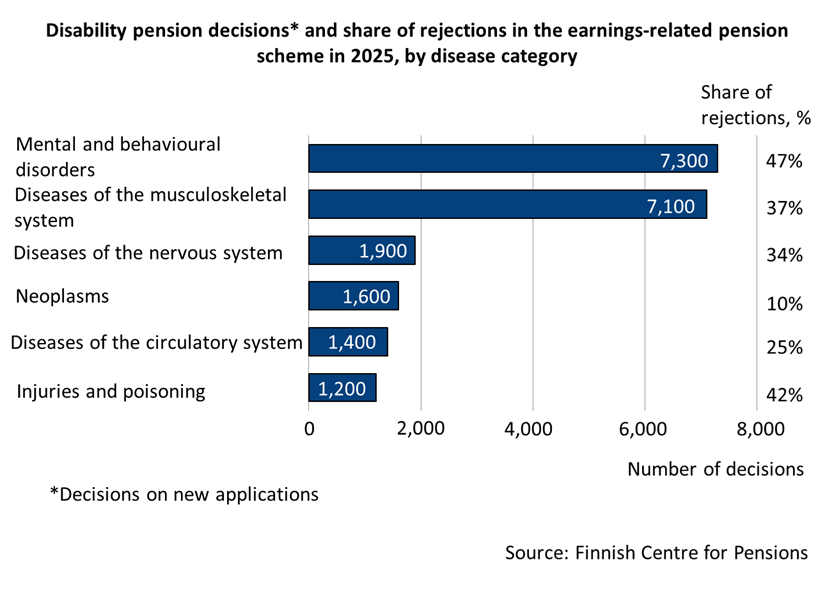
In 2025, mental and behavioural disorders were listed as the main cause for disability in most disability pension applications (7,300 applications). 47 per cent of these applications were rejected. Applications for disability pensions due to musculoskeletal disorders were submitted in nearly the same volume (7,100 applications). 37 per cent of these applications were rejected. These two major disease categories accounted for approximately two-thirds of all disability pension applications, clearly standing out in terms of volume compared to other groups. The number of applications for the next most prevalent disease groups ranged between 1,000 and 2,000 applications.
(Updated on 30 January 2026)
Average total processing times for earnings-related pension applications in 2025
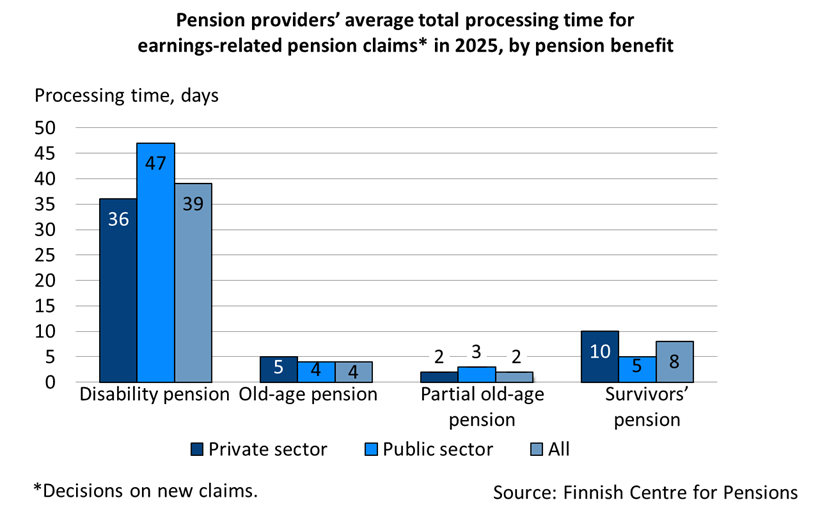
In 2025, disability pension applications were processed by earnings-related pension providers in 39 days on average. The average processing time for full old-age pension applications was four days and for partial old-age pension applications two days. On average, survivors’ pensions applications were processed in eight days.
Compared to 2024, there were small changes in processing times in 2025. On average, survivors’ pension applications and full old-age pension applications were processed one day faster. Disability pension applications, on the other hand, were processed four days faster.
(Updated on 30 January 2026)
Statistical tables:
Read more on Etk.fi:
Statistical services provides further information:
Tables in our statistical database:
Previous releases in the shared open repository Julkari:
Pension applications
Producer: Finnish Centre for Pensions
Website: Pension applications
Subject area: Social security
Part of the Official Statistics of Finland (OSF): No
Description
The statistics contain data on earnings-related pension providers’ average processing times for earnings-related pension applications. They also includes data on disability pension application decisions.
Data content
The statistics contain data on the average total processing times for earnings-related pension applications, by pension benefit. They also include data on the share of applications processed in less than three months.
Regarding disability pension decisions, the statistics present numerical data on granted and rejected applications, as well as onthe share of rejected applications.
Classifications
The data on processing times have been classified according to sector of work and pension benefit.
Disability pension decisions have been classified according to gender, age and main disease.
Methods of data collection and source
The statistics is based on the registers of the earnings-related pension system.
Update frequency
The data is updated once a year.
Time of completion or release
The data is released at the beginning of the year following the statistical year. For a more detailed schedule, consult the Release Calendar.
Time series
The first earnings-related pension application data is from the year 2005.
Key words
earnings-related pensions, disability pensions, earnings-related pension applications, processing time
Concepts and Definitions
The total processing time
The total processing time is the time that begins on the date on which the application has been received and ends on the date on which the pension provider has issued its decision.
The processing times are for national pension applications.
The processing times for disability pensions do not include applications for continued pension.
Disability pension decisions
The disability pension decisions are for new applications. This means that the applicant has neither received a disability pension nor a rejected or a preliminary pension decision in four years before this application.
Private-sector pension providers include earnings-related pension insurance companies, industry-wide and company pension funds. Keva manages the majority of all public sector pension matters.
The main disease category classification used in disability pension decisions is the IDC-10 classification of diseases.
1. Contact
1.1 Contact organisation
Finnish Centre for Pensions
1.2 Contact organisation unit
Planning Department
1.3 Contact name
1.4 Contact person function
Statistical expert
1.5 Contact mail address
Finnish Centre for Pensions
FI-00065 ELÄKETURVAKESKUS
Finland
1.6 Contact email address
firstname.lastname@etk.fi
Contact form
1.7 Contact phone number
+358 29 411 20
1.8 Contact fax number
Fax: +358 9 148 1172
2. Metadata update
2.1. Metadata last certified
30 January 2026
2.2. Metadata last posted
30 January 2025
2.3. Metadata last update
30 January 2025
3. Statistical presentation
3.1. Data description
The statistics contains data on earnings-related pension providers’ processing times for earnings-related pension applications. It also includes data on disability pension application decisions.
3.2. Classification system
Disability pension decisions have been classified according to sector of work, gender, age and main disease. The main disease categories follow the IDC-10 classification of diseases.
The data on average processing times have been classified according to sector of work and pension benefit.
3.3. Sector coverage
The statistics contains data on all persons who have applied for a pension from the Finnish earnings-related pension system.
3.4. Statistical concepts and definitions
The concepts and definitions have been presented on the statistics page.
3.5. Statistical unit
Pension application
3.6. Statistical population
Persons who have applied for a pension from the Finnish earnings-related pension system
3.7. Reference area
Finland
3.8. Time coverage
The statistics has been compiled since 2017. The time series has been produced in retrospect as of the statistical year 2005.
4. Unit of measure
Data on disability pension decisions: number of decisions
The proportion of rejected decisions among the number of applications processed: %
Processing time: days
5. Reference period
Calendar year
6. Institutional mandate
6.1. Legal acts and other agreements
The Act on the Finnish Centre for Pensions states that the Finnish Centre for Pensions is responsible for statistical activities within its field of competence.
7. Confidentiality
7.1. Confidentiality – policy
The Finnish Centre for Pensions is committed to data protection as a fundamental principle of statistics, which ensures the confidentiality of data.
7.2. Confidentiality – data treatment
Data is protected by the necessary physical and technical solutions at the various stages of processing. Personnel have access only to the data necessary for their work. Third parties do not have access to the premises where the data is processed. Employees signed a confidentiality agreement when they were hired.
8. Release Policy
The statistics of the Finnish Centre for Pensions are released on weekdays at 9.00 a.m. local time on the website of the Finnish Centre for Pensions. Any exceptions to the release time are announced separately.
The data in the statistical database are released as open data. The database’s open interface can be freely used under the CC BY 4.0 licence when the Finnish Centre for Pensions is cited as the source of the statistical data.
8.1. Release Calendar
The release dates of the statistics are published in the release calendar. The release calendar for the following year is published towards the end of the year.
8.2. Release calendar access
8.3. User access
The statistics are available to everyone when they are published on the website of the Finnish Centre for Pensions at a previously announced date.
Embargo policy: Media that are bound by the journalist’s guidelines may request material from the Finnish Centre for Pensions’ Communications Department.
Communications’ contact details
9. Frequency of dissemination
The statistics are published once a year.
10. Accessibility and clarity
10.1. News release
The releases of the statistics can be found in the shared open repository Julkari:
10.2. Publications
–
10.3. Online database
10.4. Microdata access
The Finnish Centre for Pensions’ registry data can be requested for scientific research use.
Register data can be used for research purposes in accordance with the Publicity Act, Data Protection Act, and the Act on the Secondary Use of Health and Social Data (hereinafter Act on Secondary Use), even though individual-level data is confidential. The research must be individualized and scientific and based on a research plan. Register data are not disclosed for commercial purposes.
Apply for research access to register data of the Finnish Centre for Pensions
11. Quality Management
11.1. Quality assurance
The Finnish Centre for Pensions is committed to the quality principles of Official Statistics of Finland. Our statistical production follows the quality criteria of Official Statistics of Finland, which are compatible with the European Statistics Code of Practice.
11.2. Quality assessment
The quality of the statistics is assessed at several stages in the statistical process.
12. Relevance
12.1. User needs
Feedback from users is gathered through customer surveys. Feedback is also collected through direct contact. The feedback received is monitored and considered when developing the statistics.
13. Accuracy and reliability
13.1. Overall accuracy
The data is based on operational registers which include data on a person’s pension entitlements.
14. Timeliness and punctuality
14.1. Timeliness
The data of the statistics is released in January of the year following the statistical year.
15. Coherence and comparability
15.1. Comparability – geographical
–
15.2. Comparability – over time
The statistics has been released since 2017. The time series has been produced in retrospect as of the statistical year 2005. The time series is comparable accross the entire period covered by the statistics.
16. Cost and burden
The production of the statistics is financed annually by the Finnish Centre for Pensions.
17. Data Revision
–
18. Statistical processing
18.1. Source data
The statistics is based on the registers of the Finnish Centre for Pensions.
18.2. Frequency of data collection
–
18.3. Data collection
Administrative registers.
18.4. Data validation
Adjustments are made at different stages of statistical production in accordance with the production processes of the Finnish Centre for Pensions. In addition, the results are compared with changes in legislation and with data from previous statistical years.
18.5. Data compilation
The data is extracted from the registers of the Finnish Centre for Pensions. Further processing produces aggregated data and statistical tables.