Growth in pensioners’ employment has stalled
For many years, the number of old-age pensioners has been on the rise, but now the trend has levelled off. The rising retirement age has led to a decline in the number of working pensioners. Working particularly attracts pensioners who are highly educated and have higher incomes.
Over the past two decades, working while drawing a pension has steadily become more common in Finland. According to statistics from the Finnish Centre for Pensions, more than 180,000 pensioners worked throughout 2024, of whom nearly 100,000 were under the age of 68. However, last year saw a shift in this pattern, as the number of old-age pensioners in employment ceased to grow.
“At the end of 2024, around 81,000 old-age pensioners were in employment. This was a few thousand fewer than in 2023. As the retirement age for the old-age pension rises and people continue working for longer, the number of pensioners in work is declining,” explains Jari Kannisto, Development Manager at the Finnish Centre for Pensions. Kannisto emphasises that pensioners work less regularly than the general population, so employment fluctuates from month to month. Pensioners tend to work less in the summer than in the winter months.
Rising retirement age and economic downturn are having an effect
The end of a prolonged period did not come as a complete surprise to Kannisto. The rising retirement age is reflected in the statistics, but the stagnation in growth also points to a downturn in the economy.
“When a prolonged recession has weakened employment prospects for the entire population, it has inevitably affected the job opportunities available to pensioners as well.”
Nevertheless, the situation can hardly be described as poor. The employment rate for those over 65 continues to rise as more people choose to continue working after reaching their retirement age.
“We have considerable workforce potential among those aged 65 to 70. In this group, there are both individuals extending their careers and pensioners who work. Encouraging employment within this age group is crucial if we wish to keep older people active in the labour market.”
Most working old-age pensioners are under the age of 70
According to statistics from the Finnish Centre for Pensions, old-age pensioners most likely to be in work are those between the ages of 65 and 68. In these age groups, around 7,000 to 8,000 are still working.
Working for even half a year is no longer uncommon.
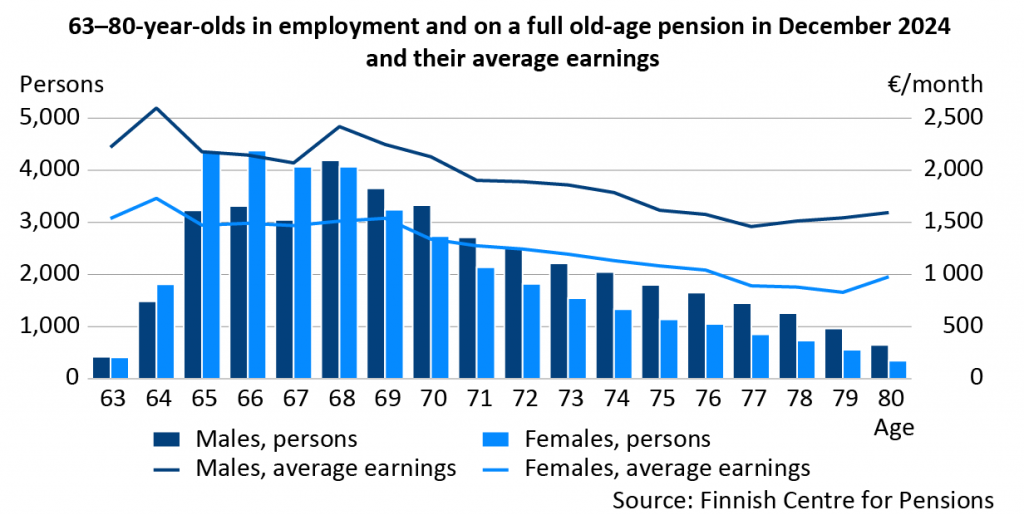
“In 2024, old-age pensioners under the age of 68 worked, on average, for just over six months. Those aged 70 worked for an average of just over five months,” says Kannisto.
Among the older age groups, working is less common. Of those aged 80, only around 1,000 old-age pensioners are in employment.
The older the age group, the smaller the proportion of men among those alive. Yet, the majority of pensioners in the older age groups who are working are men.
A growing proportion of pensioners’ income comes from working
The increasing number of pensioners in employment is also reflected in their income structure. Senior Researcher Anu Polvinen from the Finnish Centre for Pensions has studied employment among old-age pensioners under 80 and their income in 2010, 2016, and 2023.
In 2023, one in five old-age pensioners received at least 500 euros a year in earned income from work or self-employment. Nearly one in ten earned over 10,000 euros from working.
“The proportion of pensioners’ gross income coming from wages or self-employment has increased. In 2023, earnings from work accounted for an average of one quarter of pensioners’ income, whereas in 2010, the corresponding figure was roughly one fifth among those who received more than 500 euros a year from work,” Polvinen explains.
Managers and self-employed more likely than others to continue working in retirement
According to research by the Finnish Centre for Pensions, individuals with higher levels of education and income are more likely to work while drawing an old-age pension.
”Most pensioners who continue working do so for reasons other than financial necessity, although the additional income does play a role.”
“Over the past decade or so, the number of people working in retirement has increased across all educational backgrounds, but most notably among those with upper secondary education and average incomes. Among professional groups, managers, senior specialists, farmers and the self-employed are the most likely to continue working”, Polvinen states.
Did you know this?
You earn new pension for work you do in retirement
You earn new pension for work you do while drawing a pension, at a rate of 1.5 per cent of your annual earnings.
You must claim the pension separately. It will be paid out once you reach the age at which your insurance obligation ends. In 2026, this limit will be 69 years.
Pension income is taxed differently from earnings. Therefore, if you work while drawing a pension, you will need two tax codes—one for your pension and one for your wages.
Read more