Statistics on pensioners in Finland

Statistics on Pensioners in Finland includes data on all recipients of earnings-related and national pensions. The data on pension recipients living in Finland and abroad are presented separately. The statistics is produced in co-operation with the Social Insurance Institution of Finland (Kela).
Statistics on pensioners in Finland in 2025
- The average total pension received by pensioners was 2,138 euros per month in 2025, with the median pension amounting to 1,886 euros per month.
- Women received an average monthly pension of 1,930 euros, while men received 2,388 euros.
- The highest pensions were paid in Uusimaa, and at the municipal level, the largest pensions were paid in Kauniainen.
- On average, the smallest pensions were found in South Ostrobothnia.
- The number of people receiving disability pensions has been declining each year.
On this web page
- Pension recipients
- Amount of pension
- Recipients of old-age pensions
- Recipients of disability pensions
- Recipients of survivors’ pensions
- Pension recipients living abroad
Pension Recipients
1.65 million pension recipients
At the end of 2025, statutory pensions were paid in Finland to 1,650,000 persons. Statutory pensions include earnings-related pensions, national pensions, the guarantee pension, and special provision pensions.
Of the total number of pension recipients, earnings-related and national pensions were paid to 1,643,000 persons, the guarantee pension to 116,000 persons, and special provision pensions to 24,000 persons.
Table: Recipients of a statutory pension
Recipients of earnings-related and national pensions
At the end of 2025, a total of 1,643,000 persons were receiving earnings-related and national pensions. Of these, 98 per cent resided in Finland. Hence 28 per cent of the Finnish population received some form of pension. A total of 37,000 pension recipients resided abroad.
Among recipients of earnings-related and national pensions, 68 per cent received only an earnings-related pension. 27 per cent received both an earnings-related pension and a national pension, and 5 per cent received only a national pension.
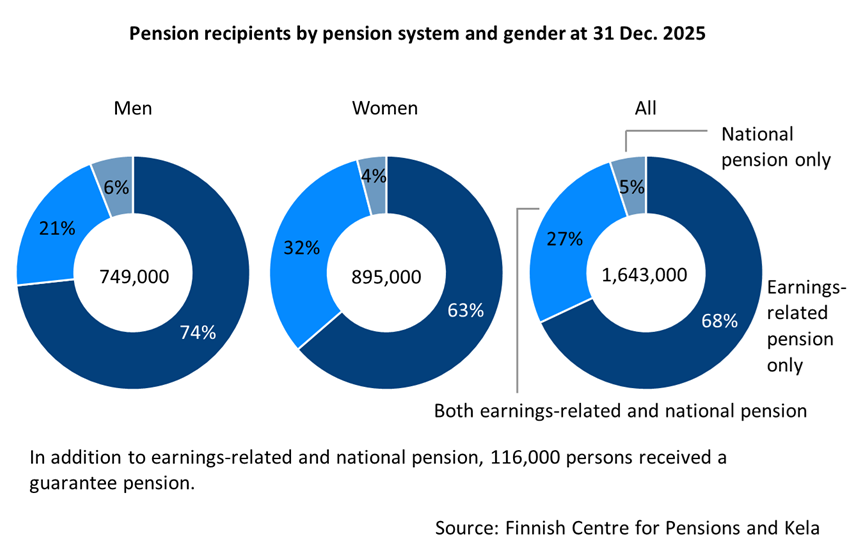
Table: Pension recipients by pension system and gender at 31 Dec. 2025 (Excel)
Younger pension recipients often receive only a national pension while among the older, working-age population, the share of earnings-related pension recipients is higher.
At the end of 2025, nearly 90 per cent of the 20–29-year-olds received only a national pension. More than 60 per cent of the 30–39-year-olds received only a national pension. In the age group 40–49-year-olds, the share receiving only a national pension was 43 per cent. In this age group, 29 per cent received both an earnings-related pension and a national pension while 28 per cent received only an earnings-related pension.
In the age group 50 and over, the share of persons receiving only a national pension dropped steeply, and was around 2 per cent among those over 60. On the other hand, the share of persons receiving only an earnings-related pension is growing. Around 50 per cent among those aged 50–59, around 74 per cent among those aged 60–69, and 71 per cent among those aged 70–79 received an earnings-related pension only. Even among those aged 80 and over, a clear majority (68%) received only an earnings-related pension at the end of 2025.
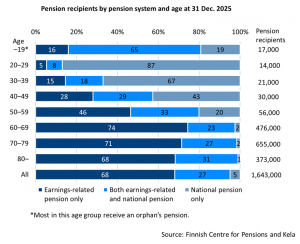
Table: Pension recipients by pension system and age at 31 Dec. 2025 (Excel)
Recipients of pensions in one’s own right
Recipients of a pension in one’s own right include those receiving an old-age pension, a disability pension or a special farmers’ pension.
In 2025, of the total number of pension recipients residing in Finland, 1,578,000 received a pension in one’s own. Of them, 54 per cent were women and 46 per cent were men. When reviewed by pension benefit, women were in the majority in all other pension benefits but the disability pension. Among old-age pension recipients, 55 per cent were women, and for those receiving a special farmers’ pension, 80 per cent were women. In contrast, there were slightly more men (51%) than women receiving disability pensions.
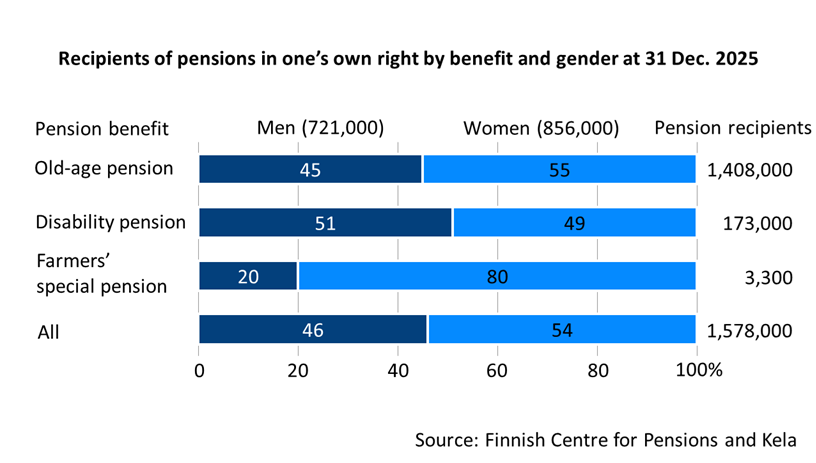
Table: Recipients of pensions in one’s own right by benefit and gender at 31 Dec. 2025 (Excel)
Women in the majority in older age groups
Of all persons receiving a pension in one’s own right, 84 per cent (1,328,000 persons) were 65 years or older. The largest group of recipients of a pension in one’s own right were the 65–69-year-olds and the 70–74-year-olds, both with around 330,000 persons.
The share of men receiving pensions in one’s own right was higher in almost all age groups below 65 years. However, the differences between men and women were small.
Among the over-65-year-old pension recipients, women were in the majority. The older the age group, the higher the share of women. Of the 65–69-year-olds, women accounted for 52 per cent; of the 80–84-year-olds, for 58 per cent, and of those aged 90 and over, 71 per cent were women.
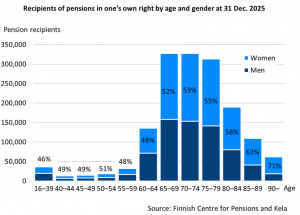
Table: Recipients of pensions in one’s own right by age and gender at 31 Dec. 2025
Population share of recipients of pensions received in one’s own right
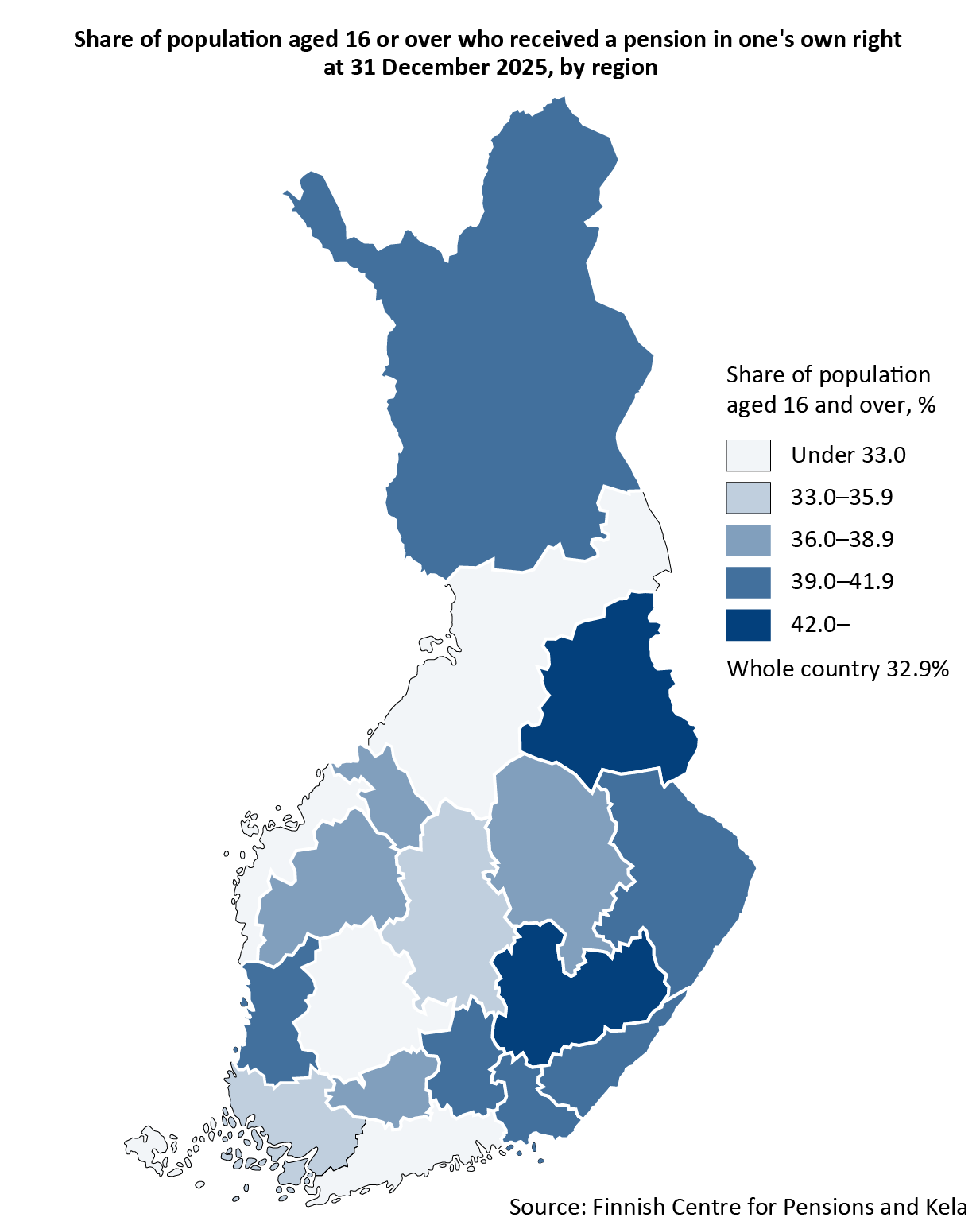
The share of the population aged 16 and over who received a pension in their own right was 33 per cent in 2025. This share has remained steadily around 33 per cent in recent years.
Population shares vary greatly between regions
When reviewed by region, the share of the population that was 16 years or older and received a pension in one’s own right in 2024 was smallest in Uusimaa (26%), Pirkanmaa (31%) and the Åland Islands (32%).
The largest population shares were in South Savo (46%), Kainuu (44%) and Kymenlaakso (42%).
Amount of pension
Average monthly amount of pension received in one’s own right 2,138 euros
On average, recipients of a pension received in one’s own right was 2,138 euros in 2025. The average gross monthly pension for men was 2,388 euros and for women 1,930 euros. The figures do not include recipients of the partial old-age pension.
The median monthly pension of those receiving a pension in one’s own right in 2025 was 1,886 euros (€2,102 for men and €1,742 for women). Women’s pensions are smaller mainly due to women’s lower average wages and shorter careers compared to men’s.
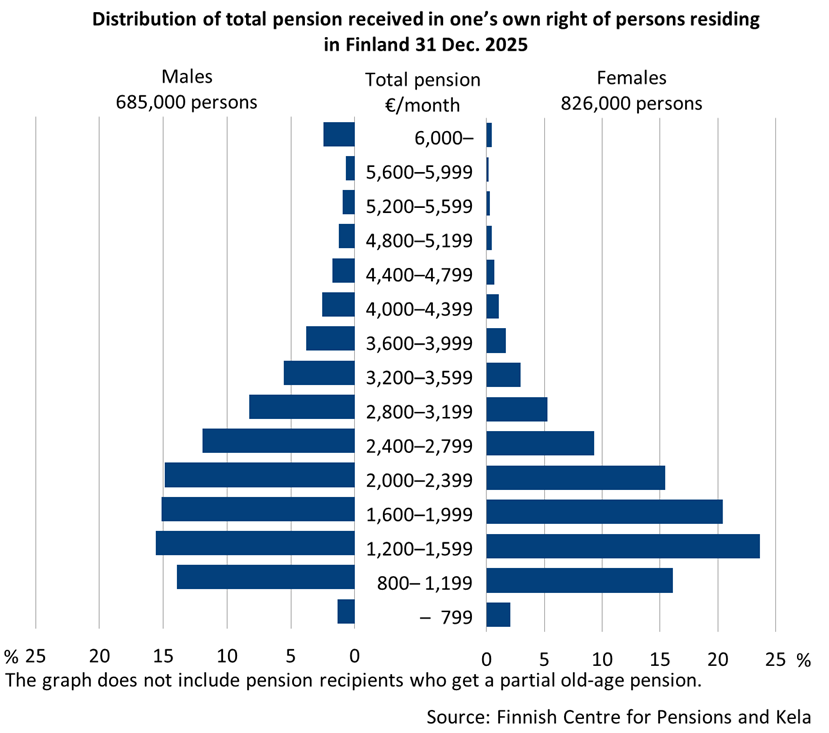
Of the pension recipients receiving a pension in one’s own right and residing in Finland, the total monthly pension was less than 2,000 euro (62% of women and 46% of men). A total monthly pension of more than 4,000 euros was paid to 6 per cent of the pension recipients (10% of men and 3% of women).
A monthly total pension of more than 6,000 euros was paid to over 1 per cent of the pension recipients in Finland. The majority (81%) of these were men.
Average pensions by region
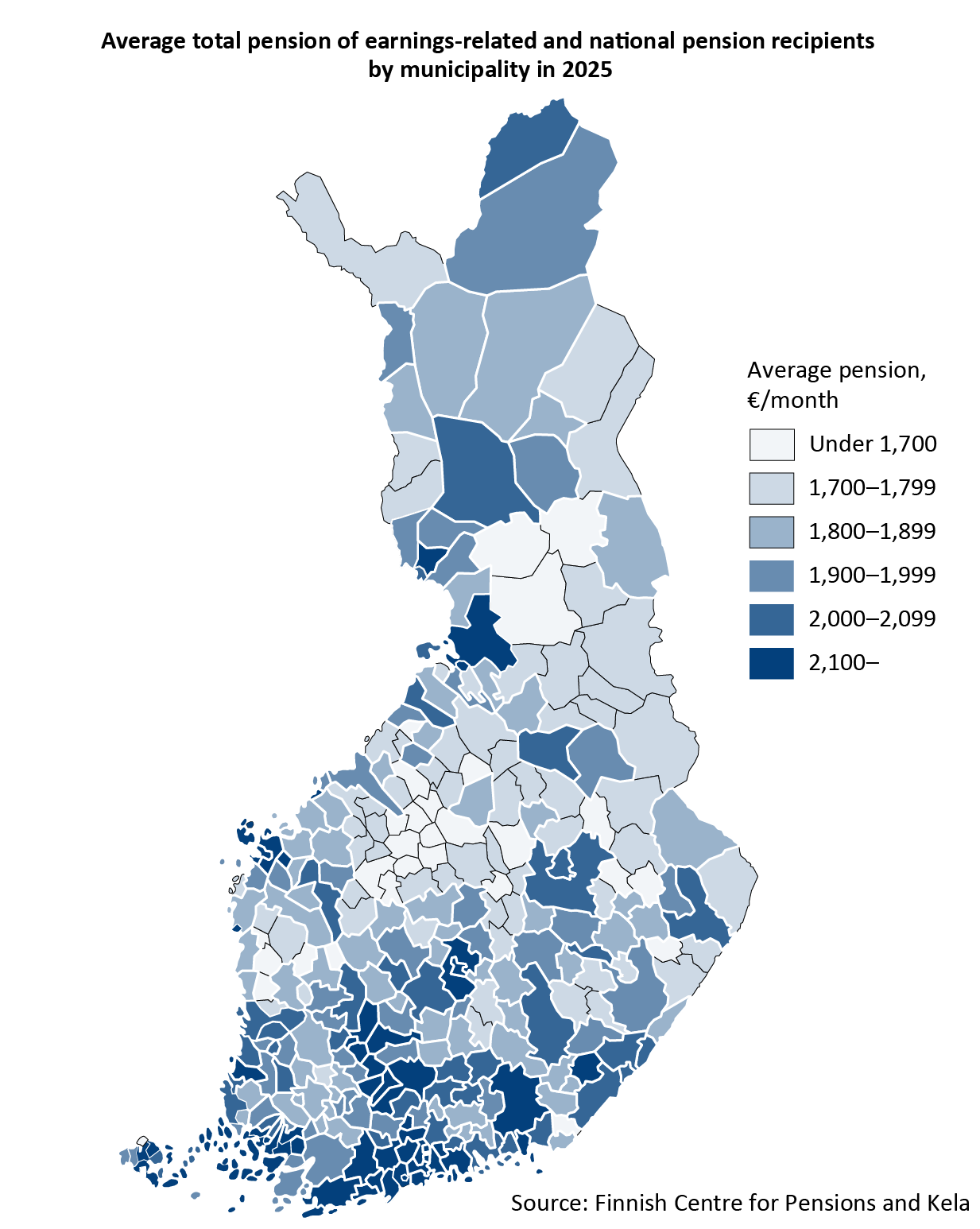
In 2025, the largest monthly pensions were paid in Uusimaa (€2,513 on average), Åland (€2,268) and
Southwest Finland (€2,123).
At a municipal level, the largest monthly pensions were paid in Kauniainen (€3,850 on average) and Espoo €2,846).
On average, the smallest monthly pensions were paid in South Ostrobothnia (€1, 872), North Karelia (€1,882) and Central Ostrobothnia (€1,893).
Old-age pension recipients
Old-age pension recipients residing in Finland numbered 1,408,000 at year-end 2025. Of them, 55 per cent were women and 45 per cent were men. Of all old-age pension recipients, a total of 67,000 persons received a partial old-age pension.
Around 72 per cent (1,011,000 persons) of all old-age pension recipients received an earnings-related pension only. Of men, 79 per cent received an earnings-related pension only; of women, 66 per cent. Of all old-age pension recipients, 27 per cent received both an earnings-related and a national pension and 2 per cent received a national pension only.
Almost half of old-age pensioners were 75 years or older
The number of old-age pension recipients under age 65 has dropped steeply in recent years. For example, around 108,000 persons under age 65 received an old-age pension in 2017. In 2020, the figure was 76,000 persons. In 2025, old-age pension recipients aged under 65 numbered 20,000. They accounted for 2 per cent of all old-age pension recipients. Approximately 650,000 old-age pensioners were aged 65–74 years, which is 48 per cent of all old-age pensioners. Of all pension recipients, half were aged 75 or older, while 13 per cent were 85 or older.
The older the age groups, the higher the share of women old-age pension recipients. Clearly less than half (42%) of the under-65-year-olds were women. Of the 65–74-year-olds, women accounted for 52 per cent. Of those 75 or older, women were in a clear majority (58%).
Average monthly amount of old-age pension 2,233 euros
The average gross monthly total pension of old-age pension recipients in 2025 was 2,233 euros (€2,521 for men and €2,001 for women). The figures do not include recipients of a partial old-age pension.
The median monthly old-age pension for those receiving an old-age pension was 1978 euros in 2025 (€2,224 for men and €1,816 for men).
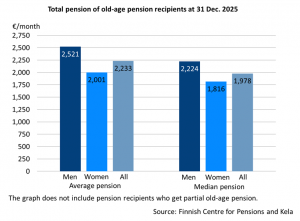
Table: Total pension of old-age pension recipients at 31 Dec. 2025 – Average value (Excel)
Table: Total pension of old-age pension recipients at 31 Dec. 2025 – Median value (Excel)
Majority of partial old-age pension recipients had drew half of their pension
At the end of 2025, around 36,100 men and 30,500 women received a partial old-age pension (a total of 67,000 persons). The number of partial old-age pension recipients decreased by 4,000 persons compared to 2024.
The pension amount is determined by the individual’s choice and is set at either 25 or 50 per cent of the earnings-related pension accrued up to that point. Among men, 86 per cent opted for the higher pension, compared to 76 per cent of women.
Average monthly partial old-age pension of 807 euros
In 2025, the average total monthly pension of partial old-age pension recipients was 807 euros (907 euros for men and 690 euros for women).
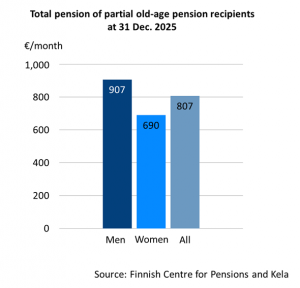
Table: Total pension of partial old-age pension recipients at 31 Dec. 2025 (Excel)
Disability pension recipients
Number of disability pension recipients down by more than 20 per cent in one decade
In 2025, around 173,000 disability pension recipients resided in Finland. This is around 45,000 less than in 2015, when disability pensions were paid to 218,000 persons.
The number of disability pension recipients has declined among both men and women. At year-end 2015, a total of 112,000 men and 106,000 women received a disability pension. At year-end 2025, the corresponding figure was slightly under 90,000 for both men and women.
One third of the disability pension recipients have turned 60
One third of all disability pension recipients were 60 years or over in 2025. Around 18 per cent were aged 55–59, and 19 per cent were aged 45–54. The share of disability pension recipients under age 35 was 15 per cent.
Disability pension recipients were equally divided between men and women. The share of men was slightly higher in the younger age groups, but the share of women increased in the higher age groups. Of those aged 60 or over, only slightly more (51%) were women.
Mental and behavioural disorders the cause of disability for more than half
Of the disability pension recipients in 2025, around 55 per cent (97,000 persons) suffered from mental and behavioural disorders. The share was equally high for men and women.
The second-largest cause for disability were musculoskeletal diseases, based on which 16 per cent (29,000 persons) received a disability pension. Around 18 per cent of the women suffered from musculoskeletal diseases and 15 per cent of the men. All other main disease categories accounted for less than 10 per cent each.
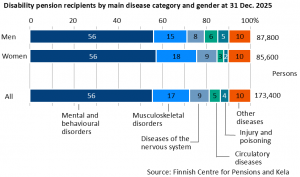
Table: Disability pension recipients by main disease category and gender at 31 Dec. 2025
Depression the main cause of retirement on a disability pension
A total of 98,000 persons received a disability pension due to mental disorders. Of them, 28 per cent suffered from depression. 36 per cent of the women and 20 per cent of the men were diagnosed with depression. The older the pension recipient, the more often depression is the cause for disability.
Share of disability pensions has declined over the last decades
In 2025, around 5 per cent of the Finnish population aged 16–64 received a disability pension. The share of disability pension recipients has declined clearly long-term; only a couple of decades ago, the share of disability pension recipients of the total working-age population was 7.4 per cent. The region with the lowest proportion of disability pension recipients relative to the population was Uusimaa, where 3.3 per cent of people aged 16–64 were on a disability pension. The next lowest shares were in Åland (3.5%) and Ostrobothnia (4.1%). The highest proportions of disability pension recipietns were found in Kainuu (8.0%) and South Savo (7.6%).
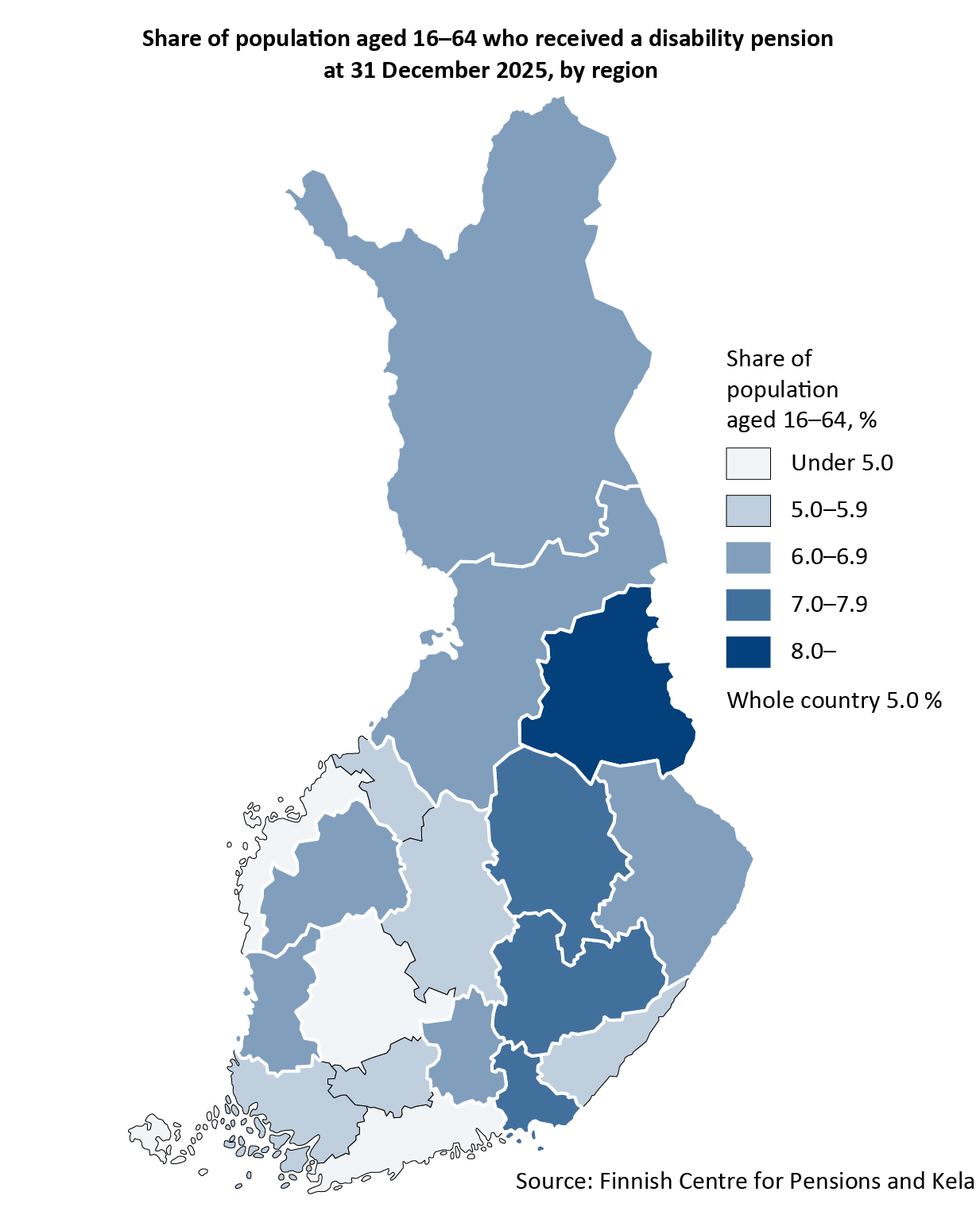
Residents of Finland who receive a disability pension: number of persons and average total pension
Recipients of a survivors’ pension
In 2025, survivors’ pensions were paid out to 205,000 surviving spouses and 16,000 children in Finland. Surviving spouse’s pension was paid to 179,000 women and 26,000 men.
Most recipients of the surviving spouse’s pension are older. In 2025, almost three quarters of them had turned 75. The share of surviving spouses aged 75–84 was 40 per cent and the share of older surviving spouses was 35 per cent. Around 8 per cent of all surviving spouse’s pension recipients were under the age of 65.
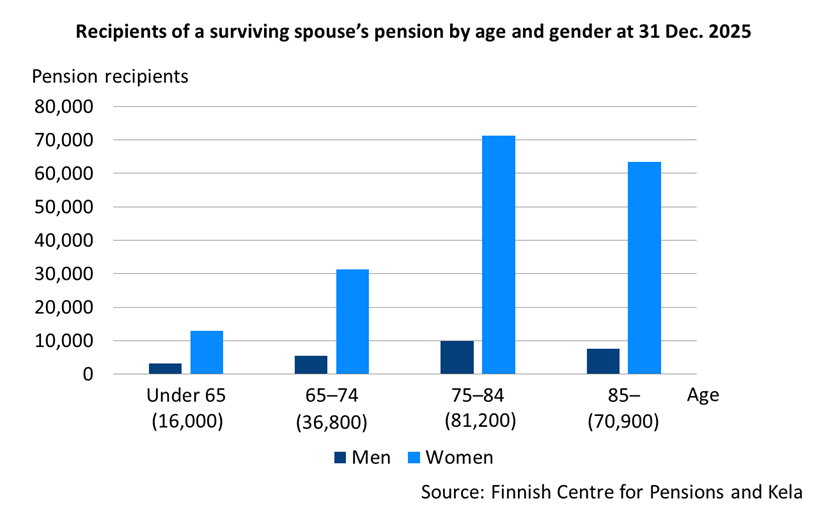
In 2025, the average monthly survivors’ pension of all surviving spouses residing in Finland was 786 euros. The average monthly surviving spouse’s pension for women was 836 euros and for men 441 euros.
The average monthly orphan’s pension of all children receiving the pension in 2025 was 798 euros.
Pension recipients residing abroad
At year-end 2025, pensions were paid out from Finland to 36,600 persons residing abroad. This represents some 2 per cent of all persons receiving a pension from Finland. More than half (53%) of the pension recipients residing abroad were Finnish citizens.
In 2025, around 88 per cent of the pension recipients residing abroad received an old-age pension. Around 3 per cent received a disability pension and 12 per cent a survivors’ pension.
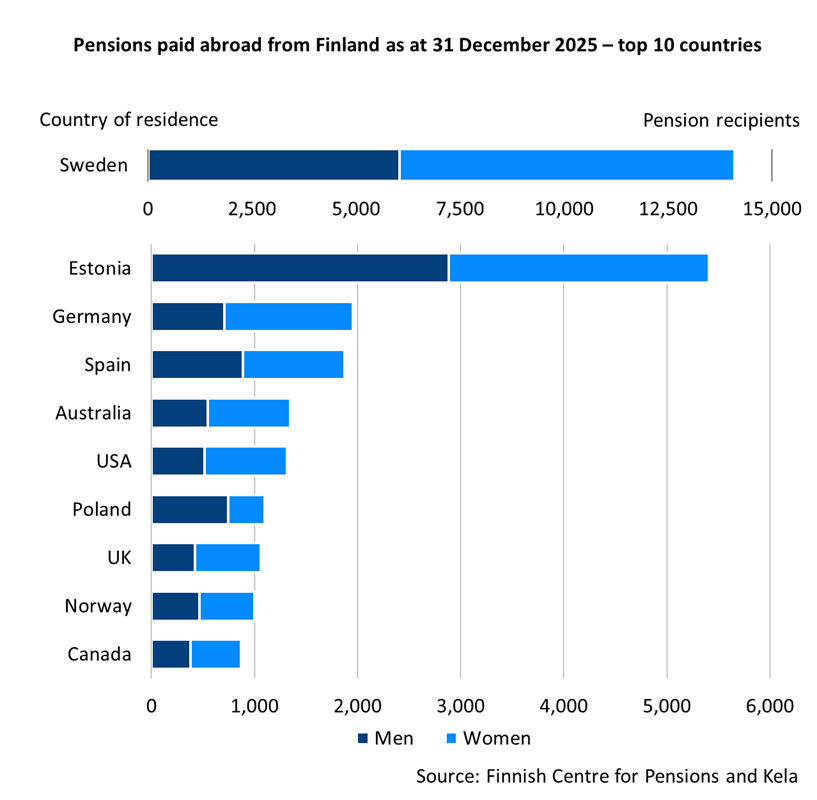
More than half of pensions paid to Sweden
In 2025, pensions were paid from Finland to more than 100 countries. Around 39 per cent of all pensions paid abroad were paid to Sweden (14,100 recipients). The next highest figures were recorded for Estonia (5,400), Germany (2,000) and Spain (1,900).
The average total monthly pension paid out from Finland in 2025 was 668 euros. However, there was significant between-country variation in average pension sizes.
Among the top 10 countries in terms of number persons receiving a pension from Finland, the highest total monthly pension payments were made to Spain (€1,724). The next highest average monthly pensions were paid to France (€1,668).
The lowest average monthly pensions were paid to Poland (€310). The next lowest payments went to pensioners residing in Australia (€395) and Sweden (€405).
(Updated on 31 March 2026)
Read more on Etk.fi:
Tables in statistical database of the Finnish Centre for Pensions:
- Number of pension recipients
- Size of pension recipients’ pension
- Share of population receiving a pension
- Pension recipients living abroad
- Number of new retirees
- Size of new retirees’ pension
Tables and graphs in Key Figures:
- Number of pension recipients
- Share of population receiving a pension
- Average total pension
- Pensions paid abroad
Our experts in this area:
- Jari Kannisto
firstname.surname@etk.fi - Joonas Hautamäki
firstname.surname@etk.fi
Statistical services provides further information:
Tables in our statistical database:
- Number of pension recipients
- Number of new retirees
- Size of pension recipients’ pension
- Size of new retirees’ pension
- Share of population receiving a pension
- Pension recipients living abroad
- Recipients of a statutory pension
- Recipients of a guarantee pension
- Recipients of a special provision pension
Statistical publications in the shared open repository Julkari:
- Statistical yearbook of pensioners in Finland (2018–)
- Statistical yearbook of pensioners in Finland (2004–2017)
News and press releases:
- Press release 31 March 2026: Average monthly pension in Finland in 2025: €2,138
- Press release 27 Mar 2025: Average monthly pension in Finland in 2024: 2,100 euros
- Press release 27 Mar 2024: Average pension in Finland nearly €2,000
- Press release 30 Mar 2023: Average monthly pension in Finland in 2022: 1,845 euros
- Press release 30 Mar 2022: Average monthly pension in 2021 in Finland: 1,784 euros
- Press release 31 March 2021: Average monthly pension in 2020 in Finland: 1,762 euros
- Press release 26 March 2020: Average monthly pension in Finland 1,716 euros
Previous releases in the shared open repository Julkari:
Statistics on Pensioners in Finland
Producers: Finnish Centre for Pensions and the Social Insurance Institution of Finland
Website: Statistics on Pensioners in Finland
Subject area: Social security
Part of the Official Statistics of Finland (OSF): Yes
Description
The statistics offers a general overview of recipients of earnings-related and national pensions in Finland.
Data content
The statistics includes data on all recipients of earnings-related and national pensions and also new pension recipients.
The data on pension recipients living in Finland and abroad are presented separately.
Classification
Pension scheme; pension benefit; pension amount; gender, age, nationality and country of residence of pension recipient; disease classification ICD-10; regional classification: municipality, province
Methods of data collection and source
The statistics is based on the registers of the Finnish Centre for Pensions and the Social Insurance Institution of Finland.
Update frequency
Twice a year.
Time of completion or release
The statistics on pension recipients is released in the spring following the statistical year. The data on new retirees is released in year after the statistical year. For a more detailed schedule, consult the Release Calendar.
Time series
The statistics has been released since 1981. The statistics has been supplemented with data on new retirees as of 2001.
For the main part, the time series of the statistics are comparable. The Quality Description (section “Coherence and comparability of data”) of the statistics includes more detailed information on the comparability of the time series.
Key words
social insurance, pension, earnings-related pension, national pension, old-age pension, disability pension, unemployment pension, farmers’ special pension, part-time pension, survivors’ pension, retirement
Pension recipient
A person who, on the last day of the statistical year, receives either a pension in one’s own right or a survivors’ pension. A person may receive pensions under several pension acts and different pension benefits at the same time. A person may receive a pension under the earnings-related pension acts and the national pension acts, a guarantee pension or a special provision pension.
Recipient of a pension in one’s own right
A person who receives an old-age pension, a partial old-age pension, a disability pension, an unemployment pension, a part-time pension, a farmer’s special pension, a guarantee pension or a disability pension under special provisions.
Recipient of a survivors’ pension
A person who receives a surviving spouse’s pension or an orphan’s pension.
Recipient of a statutory pension
A person who receives either an earnings-related or a national pension, a guarantee pension, or a special provision pension.
Recipients of statutory pensions are categorised as follows:
- All pension recipients
- Recipients of earnings-related or national pensions
- Recipients of earnings-related pensions
- Recipients of national pensions
- Recipients of special provision pensions: all; recipients of a special provision pension only; others
- Recipients of guarantee pension: all; recipients of guarantee pension only; others
Recipient of an earnings-related and national pension
A person who receives a pension in one’s own right or an old-age pension from either the earnings-related or the national pension scheme. Persons who only receive a guarantee pension or a special provision pension are not included in this category.
Recipient of a special provision pension
A person who receives a pension benefit granted under the Motor Liability Insurance Act, the Workers’ Compensation Act, the Military Injuries Act, the Act on Compensation for Military Accidents and Service-Related Illnesses or the Act on Compensation for Accidents and Service-related Illnesses in Crisis Management Duties. The pension can be a pension received in one’s own right or a survivors’ pension.
Recipient of a guarantee pension
A person who receives a guarantee pension paid by Kela. The conditions for payment are defined by the Guarantee Pension Act. Kela is responsible for the implementation of the guarantee pension. The guarantee pension is not part of the national pension scheme.
New retiree
A new retiree is a person whose pension in their own right (other than a part-time or a partial old-age pension) started during the year of statistics. A further criterion is that the person has not received a pension in their own right (excluding a part-time and a partial old-age pension) for at least two years. A person is considered a new retiree from the earnings-related or nation-al pension scheme during the year in which the transfer from said scheme took place. The cri-terion for all new retirees is that they have not received pension in their own right from either scheme for at least two years.
Persons who have started to get a part-time or a partial old-ge pension are not considered to be retired, so they are not included in the total number of new retirees. They will noo be included in the number of new retirees until the year in which they start to get some other pension in their own right.
Age
The pension recipient’s age is the age at the end of the year of statistics. A new retiree’s age is, in general, the person’s age when the pension starts. When calculating the share of new retirees in the population per age group, the person’s age at the end of the year of statistics is used.
The average age is the arithmetic mean of the ages of new retirees.
The median age is the observation at the mid-point of the material, i.e. half of the new retirees are younger than the median age and the other half are older.
Size of pension
The amounts shown in the statistics refer to the gross monthly value of pensions. The euro amounts are reported at the level for each statistical year. A pension may consist of an earnings-related pension, a national pension, a special provision pension or a guarantee pension. The average pension is calculated as the arithmetic mean of gross pensions.
Size of pension: all recipients of statutory pensions
The data are based on statutory pensions, so the total pension amount is determined by the combined value of all pensions received. This includes all benefits paid as pensions, as well as the child increase and the front-veteran’s supplement, excluding the part-time pension and the partial old-age pension. However, the pension received in one’s own right does not include the amount of any survivors’ pension received.
Size of pension: recipients of earnings-related or national pensions
The total pension amount for recipients of earnings-related and national pensions is determined by the combined value of all pensions they receive. This includes every benefit paid as a pension, as well as child increases and front-veteran’s supplements, but excludes part-time pensions and partial old-age pensions. However, pensions received in one’s own right do not include any possible survivors’ pensions.
Pension in one’s own right at retirement includes all pensions received in one’s own right that began at the time of retirement. This figure reflects the pension level of a person when they retire.
Survivors’ pension recipient’s survivors’ pension includes only the amount of the survivors’ pension, while the total pension includes all pension benefits paid to the survivors’ pension recipients.
Illness
The categorizing of persons receiving disability pension or having retired on disability pension by disease is based on the main disease which is the basis of the pension. The data on diseases is primarily based on the diagnosis of the earnings-related pension scheme.
The main groups and some subgroups of diseases are shown for the diseases.
Since 1996, the diagnoses and the corresponding codes are based on the ICD 10 classification of diseases. Disability pensions granted before 1996 are based on the previous ICD 9 classification. The codes according to the old classification have been as closely as possible placed in the correct category in the new classification.
Region
In the statistic, regions are categorized based on the regional categorization valid at the end of the year of statistics. The domicile of a person equals the domicile of the last day of the year of statistics. Data on domiciles is available from the population data of Kela.
In the statistic, countries of residence are categorized based on the country categorization valid at the end of the year of statistics. In pensions paid abroad, the person’s country of residence is the country of residence on the last day of the year of statistics. Data on country of residence is available from the population data of Kela, completed with information received from the pension providers.
Citizenship
Citizenship is categorized based on the currently valid citizenship at the end of the year of statistics. The citizenship data is acquired from Kela’s population data and completed with information received from the pension providers.
Population share
Population shares of pension recipients are calculated for pension recipients resident in Finland in per cent of the population insured for national social security benefits. The population more or less covers the resident population of the country but includes also Finnish citizens tempo-rarily living abroad.
1. Contact
1.1 Contact organisation
The Finnish Centre for Pensions and the Social Insurance Institution of Finland (Kela).
1.2 Contact organisation unit
Finnish Centre for Pensions: Planning Department, Kela: Information Services.
1.3 Contact name
Joonas Hautamäki (Finnish Centre for Pensions)
Jari Kannisto (Finnish Centre for Pensions)
Reeta Pösö (Kela)
1.4 Contact person function
Statistical expert
1.5 Contact mail address
The Finnish Centre for Pensions
FI-00065 ELÄKETURVAKESKUS
Finland
1.6 Contact email address
firstname.lastname@etk.fi
firstname.surname@kela.fi
Contact form (Finnish Centre for Pensions)
1.7 Contact phone number
+358 29 411 20 (Finnish Centre for Pensions)
1.8 Contact fax number
Fax: +358 9 148 1172 (Finnish Centre for Pensions)
2. Metadata update
2.1. Metadata last certified
27 March 2024
2.2. Metadata last posted
27 March 2024
2.3. Metadata last update
27 March 2024
3. Statistical presentation
3.1. Data description
The statistics describe the number and average pensions of persons who have received pensions from the Finnish earnings-related and national pension schemes and those who have retired.
3.2. Classification system
Pension scheme; pension benefit; pension amount; gender and age of pension recipient; disease classification ICD-10, regional classification: municipality, province, wellbeing services county and country of residence.
3.3. Sector coverage
The statistics cover all statutory pensions from the Finnish earnings-related and national pension schemes. It combines the pensions a person receives from different sources.
3.4. Statistical concepts and definitions
Concepts and definitions have been presented on the statistics page.
3.5. Statistical unit
Person / pension recipient.
3.6. Statistical population
Persons receiving a pension from the Finnish earnings-related and national pension schemes.
3.7. Reference area
Municipality, province, wellbeing services county and country of residence.
3.8. Time coverage
Basic data are available from 1981 onwards. Data on retired persons are available from 2001 onwards.
4. Unit of measure
Number of persons.
Amount of pension: €/month (gross).
Share of population: % of population covered by Kela social insurance.
5. Reference period
For pension recipients, the last day of the statistical year. For retired persons, the calendar year.
6. Institutional mandate
6.1. Legal acts and other agreements
Both the Finnish Centre for Pensions and Kela are obliged to compile statistics. The Act on the Finnish Centre for Pensions states that the Finnish Centre for Pensions is responsible for statistical activities within its field of competence. Similarly, the Act on the Social Insurance Institution states that Kela is responsible for compiling statistics, estimates and forecasts.
6.2. Data sharing
The same datasets are shared between the Finnish Centre for Pensions and Kela. Part of the data is also sent to Statistics Finland, for example for employment statistics.
Statistical data are sent annually to the NOSOSCO group for social benefits and to the Finnish Institute of Health and Welfare for the European System of Integrated Social Protection Statistics (ESSPROS).
7. Confidentiality
7.1. Confidentiality – policy
The Finnish Centre for Pensions is committed to data protection as a fundamental principle of statistics, which ensures the confidentiality of data.
7.2. Confidentiality – data treatment
Data is protected by the necessary physical and technical solutions at the various stages of processing. Personnel have access only to the data necessary for their work. Third parties do not have access to the premises where the data is processed. Employees are required to sign a confidentiality agreement when they are hired.
8. Release Policy
The Statistical Yearbook on Pensioners in Finland is a joint statistics produced by the Finnish Centre for Pensions and Kela and released on the website of the Finnish Centre for Pensions.
The statistics of the Finnish Centre for Pensions are released on weekdays at 9.00 a.m. on the website of the Finnish Centre for Pensions. Any exceptions to the release time are announced separately.
The data in the statistical database are released as open data. The database’s open interface can be freely used under the CC BY 4.0 licence, with the Finnish Centre for Pensions being cited as the source of the statistical data.
8.1. Release Calendar
The release dates of the statistics are published in the release calendar. The release calendar for the following year is published towards the end of the year.
8.2. Release calendar access
8.3. User access
The statistics are available to everyone when they are published on the website of the Finnish Centre for Pensions at a previously announced date.
Embargo policy: Media that are bound by the journalist’s guidelines may request material from the Finnish Centre for Pensions’ Communications Department.
9. Frequency of dissemination
Data on retired persons are published in March each year. Data on new retirees are published in June.
10. Accessibility and clarity
10.1. News release
The releases of the statistics can be found in the shared open repository Julkari: Statistical Yearbook of Pensioners in Finland 2023
Press releases on this topic can be found online at the website of the statistics.
Statistics on pensioners in Finland (Julkari)
10.2. Publications
Statistical yearbook of pensioners in Finland (Julkari)
Statistical yearbook of pensioners in Finland, 2004–2017 (Julkari)
10.3. Online database
Number of pension recipients (PxWeb)
Number of new retirees (PxWeb)
Size of pension recipients’ pension (PxWeb)
Size of new retirees’ pension (PxWeb)
Share of population receiving a pension (PxWeb)
Pension recipients living abroad (PxWeb)
10.4. Microdata access
The Finnish Centre for Pensions’ registry data can be requested for scientific research use.
Pension register data and Earnings and Accrual Register data on employment covered by earnings-related pension insurance can be used for research purposes in accordance with the Publicity Act, Data Protection Act, and the Act on the Secondary Use of Health and Social Data (hereinafter Act on Secondary Use), even though individual-level data is confidential. The research must be individualized and scientific and based on a research plan. Register data are not disclosed for commercial purposes.
Apply for research access to register data of the Finnish Centre for Pensions
11. Quality Management
11.1. Quality assurance
The Finnish Centre for Pensions is committed to the quality principles of Official Statistics of Finland. Our statistical production follows the quality criteria of Official Statistics of Finland, which are compatible with the European Statistics Code of Practice.
11.2. Quality assessment
The quality of statistics is assessed at several stages in the statistical process.
12. Relevance
12.1. User needs
Feedback from users is gathered through customer surveys. Feedback is also collected through direct contact. The feedback received is monitored and taken into account in the development of the statistics.
13. Accuracy and reliability
13.1. Overall accuracy
The data are based on administrative registers. The source data are at individual level and used for the payment of pensions.
13.2. Sampling error
–
13.3. Non-sampling error
The register data are extracted at the beginning of the year, when some of the retroactive pension decisions may be missing from the statistical data.
14. Timeliness and punctuality
14.1. Timeliness
The statistical data are produced in several parts, which are published in separate releases after the data quality check.
The first part is published in March of the year following the statistical reference year and the last part in June.
15. Coherence and comparability
15.1. Comparability – geographical
The regional classification (municipalities, counties, welfare regions) in force in each statistical year is used in the statistics.
15.2. Comparability – over time
The statistics have been compiled since 1981. From the beginning, they have reflected the number and average pensions of persons receiving a pension from the earnings-related and/or national pension schemes. During this period, several legislative changes have been made to both pension schemes, and the coverage of the statistics has been extended over the years. However, the time series of the statistic are broadly comparable.
The comparability of the time series is affected by the following changes:
In 1991 the statistic were completed by adding the money amounts of SOLITA pension to the pensions of persons receiving an earnings-related and/or national pension. SOLITA pensions are included in the average pensions and in the pension size distributions. They take precedence over earnings-related and national pensions, so that this additino is an essential complement to the pension coverage of these persons.
In 1996, a new concept of ‘own pension’ was introduced in the statistics, replacing the previous concept of ‘own and/or special pension’.
From the beginning of 2001, the basic component of the national pension was no longer paid. This change did not affect the total number of pensioners, but it shifted the number of recipients of both earnings-related and national pensions towards those receiving only earnings-related pensions. The abolition of the basic component was due to the transformation of the national pension into a reduced earnings-related pension at the beginning of 1996, when the national pension was no longer granted without a supplementary component. Before 1 January 1996, national pensions without a supplementary component were gradually reduced over a period of five years. With the abolition of the basic component, from 1996 onwards, a national pension paid solely as a pensioner’s housing or care allowance, child allowance or front-line allowance is not counted as a national pension for the purposes of these statistics.
Since 2008, the concept of national pension changed and the housing or care allowance of a pensioner is no longer counted among pensions. They are thus not included in the figures of this statistic or in the pension figures in the other statistics of Kela. The change slightly reduced average pensions.
Since 2011, when the Guarantee Pension Act came into force, the cash amount of the guarantee pension was added to the total pension of pensioners receiving earnings-related and/or national pension (not to pension in one’s own right or survivors’ pension.) The change raised the averages of total pensions.
As of the statistical year 2020, survivors’ pensions (the surviving spouse’s pension and orphan’s pension) that amount to 0 euro are no longer included in figures of the statistics. This change affects the number of recipients of survivors’ pensions and the average pension level.
The amount of the paid survivors’ pensions is affected by the surviving spouse’s own earnings-related pension (or calculated accrued pension) and benefits paid based on motor liability and accident insurance. Taking them into consideration may lead to a survivors’ pension of 0 euro.
From the 2025 statistical year onwards a new concept, “statutory pensions”, was introduced into the statistics. This category includes persons who previously were not counted in the statistics because they received only a guarantee pension or only a special provision pension. The statistics covers all statutory pensions. The data have been produced retrospectively from the statistical year 2011 onwards.
Before 2025, the statistics only included persons receiving either an earnings-related pension or a national pension, amounting to 1.6 million people. As a result of the change, fewer than 10,000 new pension recipients were added to the statistics. Most of the data still concerns those receiving earnings-related and national pensions. Following the expansion, the statistics also began to report, for the first time, the total pension amount for recipients of the guarantee pension and for those with special provision pensions.
15.3. Coherence – cross domain
Differences in definitions make comparisons with other statistics for the same statistical domain difficult.
These statistics cover only statutory pensions, excluding, for example, voluntary supplementary pension schemes.
15.4. Coherence – internal
The data on earnings-related pensions in this statistics correspond to the data in the statistics Earnings-related Pension Recipients in Finland, published by the Finnish Centre for Pensions.
Earnings-related Pension Recipients in Finland
The data on national pensions differ from the Kela pension statistics with regard to the concept of ‘new retiree’. The Kela statistics use the term ‘new pensions’.
16. Cost and burden
The production of the statistics is financed jointly by the Finnish Centre for Pensions and Kela.
17. Data Revision
–
18. Statistical processing
18.1. Source data
The statistics is based on the registers of the Finnish Centre for Pensions and Kela.
18.2. Frequency of data collection
–
18.3. Data collection
Administrative registers.
18.4. Data validation
Adjustments are made at different stages of statistical production in accordance with the production processes of the Finnish Centre for Pensions. In addition, the results are compared with changes in legislation and with data from previous statistical years.
18.5. Data compilation
Combination of person-level pension data extracted from the registers of the Finnish Centre for Pensions and Kela. Further processing produces aggregated data and statistical tables.
Description of the pension system in 2025
The Finnish statutory pension system consists of the statutory earnings-related pension, the national pension and the guarantee pension. In addition to these, pensions are paid based on the Motor Liability Insurance Act, the Workers’ Compensation Act, the Act on Compensation for Military Accidents and Service-Related Illnesses and the Act on Compensation for Accidents and Service-Related Illnesses in Crisis Management Duties.
The earnings-related pension scheme covers all employees, self-employed persons and farmers whose employment exceeds the minimum requirements laid down by law.
The national pension and the guarantee pension secure a basic livelihood if the retiree has accrued no or only a small earnings-related pension. The national pension scheme covers all persons who are permanently residing in Finland.
Earnings-related pension scheme
Pension accrues for work carried out between the ages of 17 and 67. For the self-employed, pension accrues as of age 18. The pension is calculated based on the person’s earnings for each year and an age-specific accrual rate. Pension also accrues based on certain unsalaried periods, such as periods of unemployment or study. A person can simultaneously receive earnings-related pensions under several pension acts and of several different types.
The Ministry of Social Affairs and Health annually confirms the earnings-related pension index and the wage coefficient. The earnings-related pension index is used to revalue the euro amounts of pensions in payment at the beginning of January each year. The wage coefficient has been used as of 2005 to calculate pensions and to revalue earnings from work, self-employed persons’ confirmed income and the limit amounts laid down in the acts on the earnings-related pension. In 2025 the earnings-related pension index was 3077 and the wage coefficient 1,673.
The national pension scheme
Pension financing
The financing of private sector earnings-related pensions is based on insurance. The financing is partly funded and partly pay-as-you-go. The expenditure of the scheme is thus covered through contributions and interest yields on the funds. Contributions under TyEL and MEL are paid jointly by the employer and the employee. Contributions under YEL and MYEL are paid in their entirety by the self-employed. The State participates in the financing of the pensions for self-employed persons insofar as the contributions and interest yield on the funds are not sufficient to finance the pensions.
Until the 1990s, the financing of public sector pensions was based on the pay-as-you-go system. In other words, enough pension contributions or taxes were collected to finance pensions in payment. Municipal pensions are the responsibility of the member entities Since 1988, in preparation for the increasing pension expenditure, assets have been collected from the member entities into a pension liability fund. Since 1990, state pension contributions have been accumulated into the State Pension Fund. Pensions are not paid directly from the State Pension Fund but from the state budget. Employees and officials of the public sector also participate in the financing of pensions by paying the employee’s pension contribution.
Kela pensions are financed by the State.
Pension legislation as at 31 December 2025
Earnings-related pension acts
Private sector
- TyEL Employees Pensions Act
- MEL Act Seafarer’s Pensions Act
- YEL Self-Employed Persons’ Pensions Act
- MYEL Farmers’ Pensions Act
- LUTUL Act on Farmers’ Early Retirement Aid
Public sector
- JuEL Public Sector Pensions Act
- OrtKL Orthodox Church Act
- SP Pension regulation for the Bank of Finland
- KELA Pension regulation for Kela
- Pension regulation for the regional government of Åland
National pension acts
- KEL National Pensions Act
- REL Front-Veterans’ Pensions Act
- URL Act on Front-Veterans’ Supplement Payable Abroad
Special provision acts
The Motor Liability Insurance Act compensates personal injuries caused by motor vehicles used in traffic. Compensations are paid based on the Workers’ Compensation Act for accidents at work (on the job or on the way to and from work) or occupational diseases.
Farmers are covered by the Accident Insurance Act for Farmers. Military injuries and service-related illnesses occurring in military service, non-military service and women’s voluntary military service are compensated under the Act on Compensation for Military accidents and Service-Related Illnesses. Accidents and service-related illnesses occurring in crisis management operations are compensated under the Act on Compensation for Accidents and Service-Related Illnesses in Crisis Management Duties.
Act on Guarantee Pensions
The guarantee pension ensures a minimum pension of a certain size for a person resident in Finland. Kela pays out the guarantee pension, which is financed by State funds. The guarantee pension is adjusted annually with the national pension index.
Pension benefits in 2023
Old-age pension
In the earnings-related pension scheme, it is possible to retire on an old-age pension flexibly between the ages of 63 and 68. The retirement age rises gradually from 63 years to 65 years with 3 months per age group. The first age group whose retirement age rises are those born in 1955.
In the public sector of the earnings-related pension scheme, it is possible to retire according to earlier agreement at an individual or occupational retirement age. Under MELA, it is possible to retire at an accrued retirement age.
From the beginning of 2017, it has been possible to retire on an earnings-related partial old-age pension. This pension is available to persons born in 1949 or later who have reached the qualifying age for the benefit, determined based on year of birth. Eligible persons may not receive any other pension in their own right at the start of the partial old-age pension. The amount of partial old-age pension is 25 or 50 per cent (based on the individual’s own choice) of the earnings-related pension accrued at the time of retirement. An early retirement reduction is made to the pension if it is taken out before the retirement age of the age group concerned. There are no rules regarding employment; partial old-age pension recipients may continue to work if they want to.
In the national pension scheme, the age limit for the old-age pension is 65 years. Persons born before 1962 can take out their national old-age pension early. The age threshold is 63 years for persons born before 1958 and 64 years for persons born in 1958–1961. Early retirement reduces the pension permanently.
Retirement on old-age pension can also be deferred. The earnings-related old-age pension is increased if taken out late, after reaching the retirement age. Under the national pension scheme, the age threshold for the increase is 65 years.
Disability pension
The earnings-related disability pension may be granted to persons who have an illness which reduces their ability to work. Besides health, the person’s possibilities of earning a living (by such available work which the person can reasonably be expected to manage considering their education and training, age, previous activities, living conditions and other comparable factors) are considered. In the public sector it suffices that, due to an illness, a handicap or an injury, the person has become incapable of doing their own job. When assessing whether a 60-year-old person with a long work history is entitled to a disability pension, the occupational nature of the work inability is emphasized especially.
A pension provider may grant a disability pension to an insured person who has turned 17 but who has not reached their retirement age (determined based on the birth year) . When the person reaches their retirement age, the disability pension will turn into an old-age pension. In the national pension scheme, the disability pension may be granted to an insured person who is between 16 and 64 years old.
In the earnings-related pension scheme, it is further required that the work inability can be estimated to last for at least one year. In the national pension scheme, the pension is not awarded to persons aged 16–19 until their possibilities of rehabilitation have been investigated. In the national pension scheme, a permanently blind person and a person permanently without mobile activity is always considered incapable of work.
The disability pension may be awarded either until further notice or as a fixed-term cash rehabilitation benefit. The cash rehabilitation benefit is granted if it can be expected that the person’s ability to work can be restored at least in part through treatment or rehabilitation. The granting of a cash rehabilitation benefit always requires a treatment or rehabilitation plan.
The earnings-related disability pension may be awarded as a full pension or a partial pension. A person is granted a full disability pension if their ability to work is considered to have been reduced by at least 3/5 and a partial disability pension if their ability to work is considered to have been reduced by 2/5 – 3/5. The partial disability pension is half of the full disability pension. A disability pension paid under the national pension scheme is not granted as a partial pension.
In the earnings-related pension scheme, the disability pension can also be granted as a years-of-service pension if the pension applicant has done work that requires great mental or physical effort for at least 38 years. In addition, the applicant’s ability to work must be reduced, but less so than for the actual disability pension. The first years-of-service pensions were paid out in 2018.
Part-time pension
Part-time pensions were granted within the earnings-related pension scheme in 1987–2016 to workers who changed from full-time to part-time work.
Survivors’ pension
After the death of the insured, the survivors’ pension may be paid to the children (orphan’s pension), the surviving spouse or a former spouse of the deceased (surviving spouse’s pension).
A child is entitled to the orphan’s pension if the child is under the age of 18 at the time of the death of the parent. In the national pension scheme, a child aged 18–20 is also entitled to an orphan’s pension if they are a full-time student or participates in vocational training (student’s pension). Children entitled to the orphan’s pension may be the deceased person’s own child, the surviving spouse’s child, the child of the surviving party to a registered relationship or an adopted child.
The surviving spouse’s pension may be granted to the surviving spouse if the spouses were married before the deceased reached the age of 65 and if the surviving spouse has or has had a child together with the deceased. If the spouses do not have a child together, the requirement is that the spouses were married before the surviving spouse reached the age of 50, the marriage had lasted for at least 5 years and that the surviving spouse had reached the age of 50 at the time of the death of the spouse. In the earnings-related pension scheme, the surviving spouse’s pension may also be granted to a surviving spouse aged less than 50, if the surviving spouse had received a disability pension continuously for at least three years before the death of the spouse. The above criteria also apply to the surviving party of a registered partnership.
In the earnings-related pension scheme, the survivors’ pension may also be granted to the deceased person’s former spouse or the divorced party to a registered partnership if the deceased person was, at the time of death, liable to pay alimony to the former spouse.
Special pensions for farmers
Special pensions for farmers are the farm-closure pension and the farmers’ early retirement aid. Farm-closure pensions were awarded from 1974 to 1992 and farmers’ early retirement aids from 1995 to 2018.
The farm-closure pension is a lifelong pension. The basic amount of early retirement aid granted after 2007 is converted to an old-age pension at the age of 63, while the supplementary component is paid until the age of 65.
Special pensions for farmers are paid within the earnings-related pension scheme only in the private sector.
Guarantee pension
The guarantee pension can be granted to a person who receives pension (old-age or disability pension, farmers’ early retirement aid or special provisions pensions) that qualifies them to receive the guarantee pension. In addition, the person’s combined pension income may not exceed the income limit for the guarantee pension. All pensions, including survivors’ and farm closure pensions, paid in Finland and from abroad affect the amount of the guarantee pension.
The guarantee pension may be granted to immigrants who have turned 65 years or disabled immigrants who are at least 16 years old. However, an immigrant is not entitled to the guarantee pension simply based on blindness or immobility. Receiving the guarantee pension requires that the person has been resident in Finland for at least 3 years since the age of 16. The guarantee pension is not paid to a person who resides abroad permanently.