Nearly half of young adults have saved for retirement

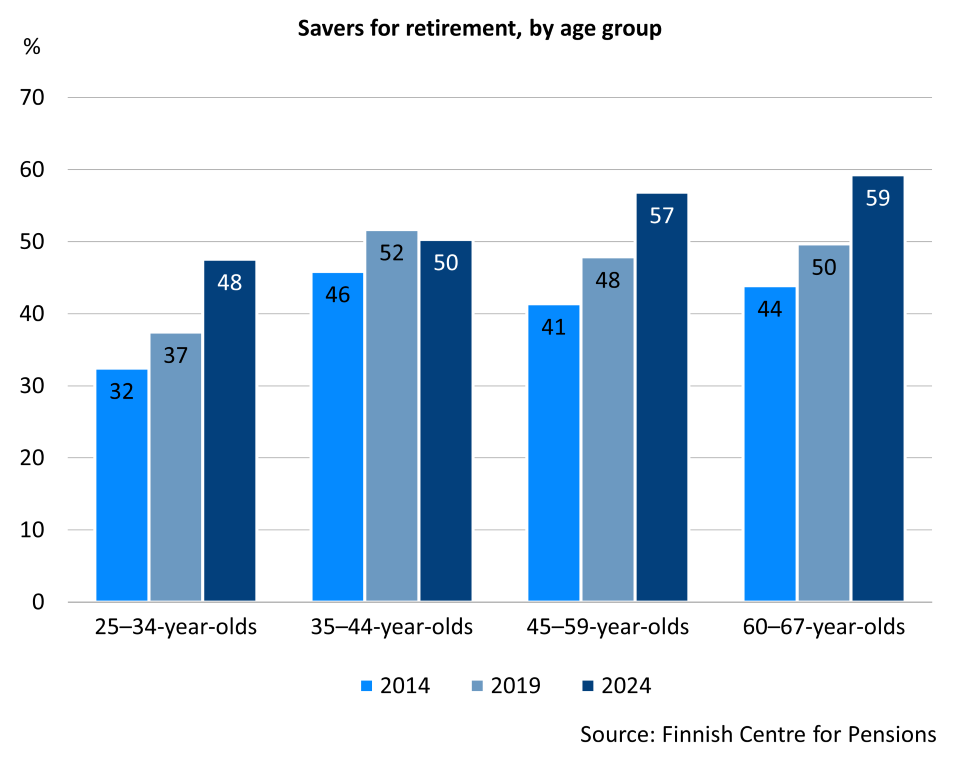
Saving for retirement has increased among all age groups, but particularly among young adults. According to a recent study by the Finnish Centre for Pensions, nearly half of the 25–34-year-olds reported in 2024 that they have saved for retirement.
In an equivalent survey in 2019, less than 40 per cent of young adults had saved for retirement. Saving for retirement is more common in all age groups the higher the income and educational level of the individuals.
Young savers sceptical about future pension adequacy
Young adults who have saved for retirement are more critical than older age groups towards the future of the pension system. They are more often sceptical about whether pensions will continue to be paid in the future and whether they will guarantee a reasonable standard of living.
In addition, the 25–34-year-olds who have saved for retirement are more doubtful about the reliability of future pension payments than are those of the same age who have not saved for retirement. The gap between savers and non-savers has widened somewhat in this respect since the previous survey in 2019.
“Nearly three in four young adults who saved for retirement were at least partly doubtful about whether pensions can be paid also in the future”, explains economist Kati Ahonen from the Finnish Centre for Pensions.
Savings intended to provide end-of-career flexibility
Compared to older age groups, young adults consider their personal savings to play a great role in their retirment income. Many anticipate using their savings to fund everyday expenses in retirement.
According to the study, a growing share of young adults intends to use their savings to retire early: half of the 25–34-year-olds. This is a clearly larger share than among other age groups.
Changing demographics and economic situation worry
The worries of young adult savers about shifts in the population structure are visible in their responses. Those who have saved for retirement are somewhat more worried about low birth rates than those who have not saved.
Economic and employment conditions are a source of concern for most young people, but this survey shows no difference in this respect between those who have saved for retirement and those who have not.
“Concern about the economic and employment situation is not necessarily reflected as saving for retirement. Some of those who have not saved are very worried about their own financial situation and, in extension, of the adequacy of their future pension, but they simply do not have the possibility to save”, says Senior Researcher Jyri Liukko from the Finnish Centre for Pensions.
Uncertainty and changing environment underpin saving habits
According to Kati Ahonen, young adults’ increasing prevalence of saving for retirment might partly be associated with a lack of trust in the pension system. Nevertheless, it is probable that various other factors also affect saving habits.
“General societal uncertainty has increased, and saving has become more common across all age groups.”
The trend of saving among young adults may also be linked to the trend of investing, which has made saving part of everyday life of young adults.
“For example, there is abundant social media content that focuses on saving and investing. These channels successfully reach young adults. It is understandable that part of the phenomenon of saving can be channelled into saving for retirement”, Ahonen points out.
Around 1,600 working-age Finns responded to the survey. Around 250 of them were aged between 25 and 34.
Research publication: Saving for retirement and trust in pensions among young adults (summary in English)
Research data on pension knowledge, trust and financial preparedness on our webpage Findings from our research.