Long-term projections: Pension financing outlook improves as equity returns gain importance
The financing outlook for earnings-related pensions has improved following Finland’s pension reform. At the same time, the future contribution rate under the Employees Pensions Act (TyEL) has become more uncertain, according to the Finnish Centre for Pensions’ new long-term projections.
In recent years, the earnings-related pension system has developed broadly as expected. Investment returns have been moderate, people have retired later, and employment among older people has increased.
The pension reform, which is due to enter into force, will particularly affect the financing of private-sector earnings-related pensions. It will allow pension assets to be invested more heavily in equities, which is expected to increase investment returns.
The Finnish Centre for Pensions’ latest long-term projections show that the financing position of earnings-related pensions is stronger than previously estimated. In the future, investment returns will play a key role. Equity returns will be particularly important for the long-term development of the contribution rate. The projections also assume higher migration and lower fertility than before.
“The financing of earnings-related pensions now appears stronger than in the previous projections. The fact that there is no upward pressure on contribution rates is a significant change compared with earlier baseline projections. A stronger financing outlook for the earnings-related pension system is, in principle, also very positive for public finances,” says Mikko Kautto, Managing Director of the Finnish Centre for Pensions.
The average contribution rate for private-sector employees has been agreed at 24.4% of wages until 2030. In the Finnish Centre for Pensions’ baseline projection, the rate then falls to just over 22% in the 2040s and starts to rise again around the middle of the century.
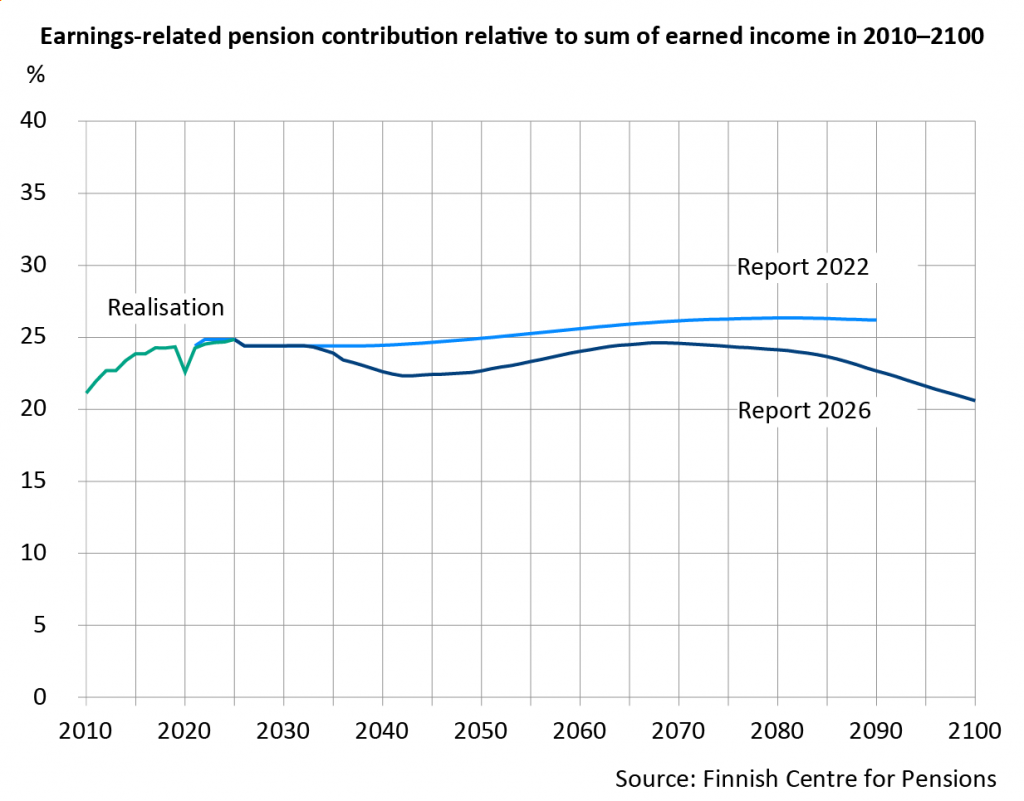
“The baseline path for the contribution rate assumes real investment returns of 3.2% at first and 3.75% later. In nominal terms, the corresponding rates are two percentage points higher because of inflation,” says Heikki Tikanmäki, Development Manager at the Finnish Centre for Pensions.
Pension assets projected to rise to €1,300 billion
The pension reform will also affect the growth of pension assets. At the turn of the year, pension assets amounted to €290 billion. In the baseline projection, they rise to €1,300 billion in today’s money by the end of the century. Relative to pension expenditure, pension assets will almost double by then.
In 2025, earnings-related pension expenditure in Finland was 33.1% of the sum of earned income. The ratio is projected to fall to just under 28% by the middle of the century. After that, it will begin to rise again and reach around 35% in the 2080s.
In the long term, earnings-related pension expenditure will increase relative to the sum of earned income mainly because the working-age population is shrinking.
The retirement of the large age cohorts will reduce pension expenditure in the coming decades. However, low fertility and increasing life expectancy will raise expenditure relative to the sum of earned income in the long term.
Average pension will grow, but more slowly than earnings
In 2025, the average pension in Finland was €2,138 per month. The Finnish Centre for Pensions estimates that the purchasing power of pensions will increase in the future. In the baseline projection, the average monthly pension will be almost €3,800 in 2100.
However, the average pension will fall in relation to average earnings by around one fifth by the end of the century. The main reason is the life expectancy coefficient.
Uncertainty is an important part of long-term projections
Alongside the baseline projection, the Finnish Centre for Pensions’ new long-term projections include a stochastic projection. A stochastic projection is a calculation that takes account of randomness and uncertainty. It gives a more detailed picture of the effects of more risk-oriented investing. In this projection, investment returns and the development of earnings and prices are treated as uncertain.
In the stochastic projection, the contribution rate starts to vary from the next decade onwards.
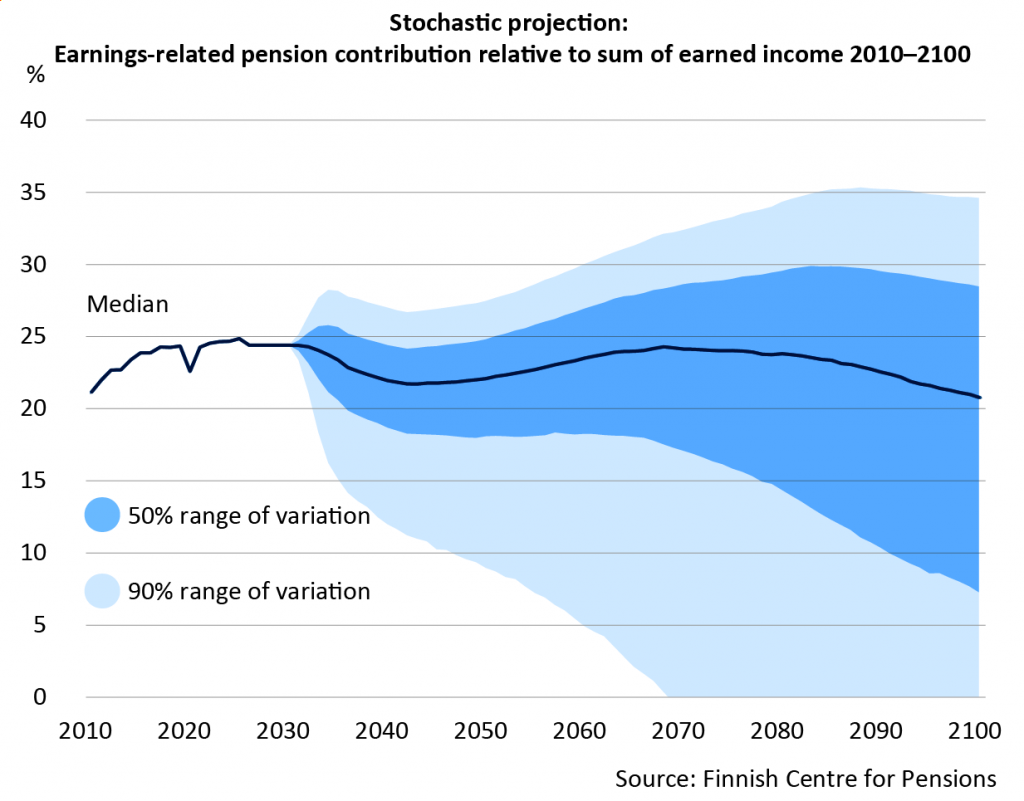
“Looking 30 years ahead, the earnings-related pension contribution will be below 29% of wages in 95% of the scenarios. Half of the results indicate a contribution rate between 18% and 26%. A quarter of the results suggest that the contribution rate could be below 18% at that time,” Tikanmäki says.
According to Tikanmäki, it is important to include uncertainty in long-term projections.
“The future is always uncertain. In stochastic projections, this uncertainty becomes visible in a natural way. At the time of the Helsinki Olympic Games in 1952, who could have imagined what the world would look like today? The period from today to the end of the projection period is just as long.”
Long-term projections are a statutory task
The Finnish Centre for Pensions has a statutory duty to produce assessments and projections of the development and financing of pension provision.
The Finnish Centre for Pensions published its previous long-term projections in October 2022. Since then, fertility has stabilised at a lower level, migration has increased, and Finland has agreed on a pension reform.
The new report includes stochastic projections, financing projections for all major pension schemes and replacement rate calculations.
The projections were prepared using the Finnish Centre for Pensions’ LTP model and the ELSI microsimulation model.
Read more:
- Lakisääteiset eläkkeet – pitkän aikavälin laskelma 2026 (Statutory pensions – long-term projections 2026, summary in English) (Julkari.fi)
- Projections (Etk.fi)