Every third Finn takes out a partial old-age pension

For many people, a monthly pension of around €900 makes everyday life easier. The partial old-age pension also allows people to reduce their working hours in the final years of their career without a major drop in income.
According to the latest statistics of the Finnish Centre for Pensions, one in three people born between 1959 and 1962 who were entitled to this pension had already started drawing it by the end of 2025. Most of them began taking the pension within a couple of years of reaching the minimum age of 61.
“The trend seems to get stronger. Most recent statistics show that an increasing number of persons take out the pension as soon as they have reached the minimum age”, says Development Manager Jari Kannisto from the Finnish Centre for Pensions.
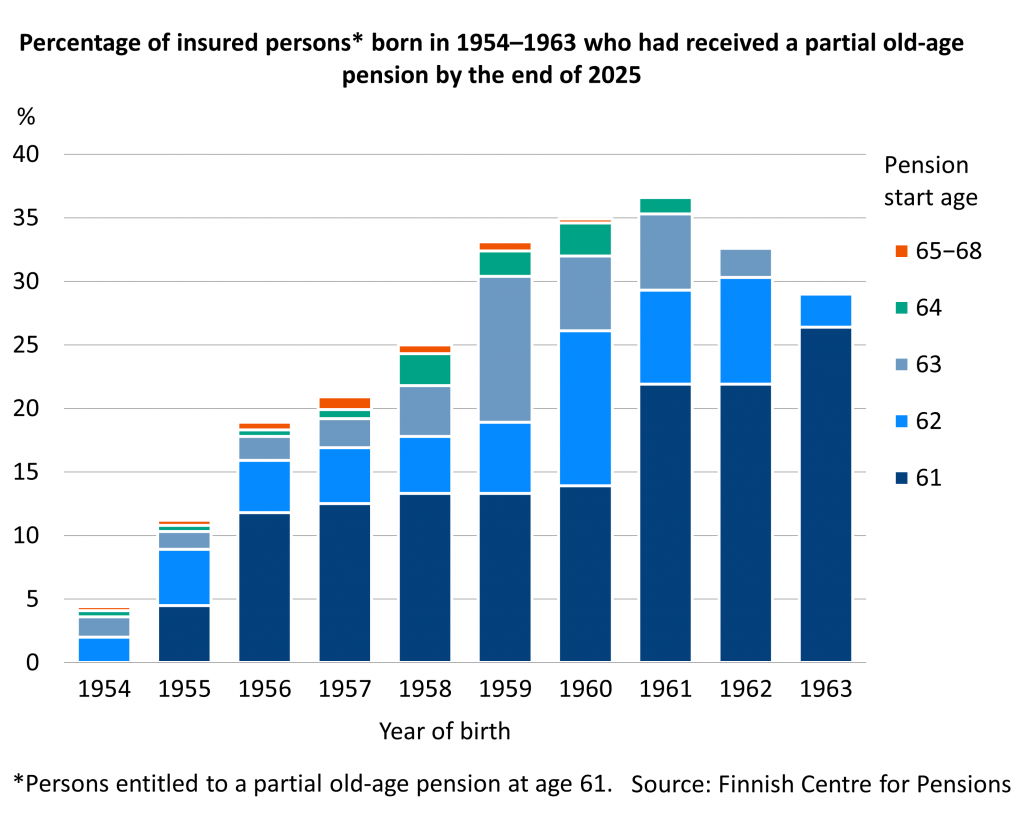
The largest number of people who started drawing a partial old-age pension at age 61 were those born in 1963 – more than 18,000 people.
More people continue working past their retirement age
Statistics show that one in three Finns who are entitled to the partial old-age pension and who have taken the benefit before reaching their retiremen age for the full old-age pension has postponed retirement on a full old-age pension past their retirement age.
Kannisto sees this as a positive sign.
“A key aim of the partial old-age pension is to help people cope better with the final years of their working life and to support them in continuing to work beyond their retirement age for the full old-age pension. In the early years, people stopped working when they reached their retirement age, but now more and more people continue working on a partial old-age pension after reaching their retirement age for the full old-age pension”, Kannisto explains.
On average, €900 per month
People can choose to take either 25 per cent or 50 per cent of their accrued earnings-related pension as a partial old-age pension. In 2025, around four in five starting partial old-age pensions were paid at the 50 per cent rate. Before tax, they averaged €930 per month.
“The amount of the partial old-age pension has incerased compared to 2025. This is because the minimum age limit has risen. People who are one year older have had more time to build up their pension, so their pension is usually slightly higher”, Kannisto assesses.
For men, the average monthly pension at the 50 per cent rate was €1,025. For women, the corresponding monthly pension was €810.
“The economic downturn has made financial difficulties worse for many Finns. The partial old-age pension has provided quick relief. However, the deduction for early retirement applied to the pension may increase financial difficulties later in life”, Kannisto points out.
Partial old-age pension may reduce the general social security benefit
This year, the partial old-age pension has become a social policy issue. The change is particularly important for people who are unemployed. In future, the partial old-age pension may reduce the general social security benefit paid by Kela. However, it does not affect earnings-related unemployment benefits.
According to Kannisto, the effect could be significant for some. For those receiving Kela’s unemployment benefits, the average monthly partial old-age pension has been just over €500. In future, an amount like this could reduce the general social security benefit by more than €100 a month.
Finns who received a decision on a partial old-age pension on or after 16 January 2026 and who start receiving the general social security benefit paid by Kela from 1 May may lose a significant part of that benefit.
“For an unemployed person who receives the general social security benefit, taking the partial old-age pension may no longer be such an attractive option. In the past, the pension did not affect unemployment benefits, but now it may be taken into account when the amount of the general social security benefit is determined. Since the partial old-age pension reduces the full old-age pension, drawing the pension may prove costly in the long run”, Kannisto warns.
“This will make it more difficult to make decisions in future. If you become unemployed after choosing a partial old-age pension, you may become dependent on the general social security benefit, in which case your income falls sharply. If you become unemployed, the partial old-age pension may no longer provide financial relief in the same way as before.”
At the end of 2025, around 3,000 unemployed partial old-age pension recipients received either the basic unemployment allowance or the labour market subsidy. From 1 May 2026, these Kela benefits were replaced by the general social security benefit, the amount of which is affected also by the partial old-age pension. However, this group will be covered by the transitional protection rule that is currently being prepared. The additional cut in the general social security benefit would not apply to them if the legislation is adopted as planned.
Legislative change to the general social security benefit under preparation
A legislative change regarding the general social security benefit is currently being prepared by the Ministry of Social Affairs and Health. The proposed amendment applies to people who received a decision on a partial old-age pension before 16 January 2026.
According to the ministry, the aim is to protect the income of these people during unemployment in cases where the decision to take out a partial old-age pension was made without knowing that the level of the general social security benefit could be affected by the partial old-age pension.
Read more