Finns delay retirement faster than predicted – Managing Director Mikko Kautto: “Public finances strengthened by the shift”
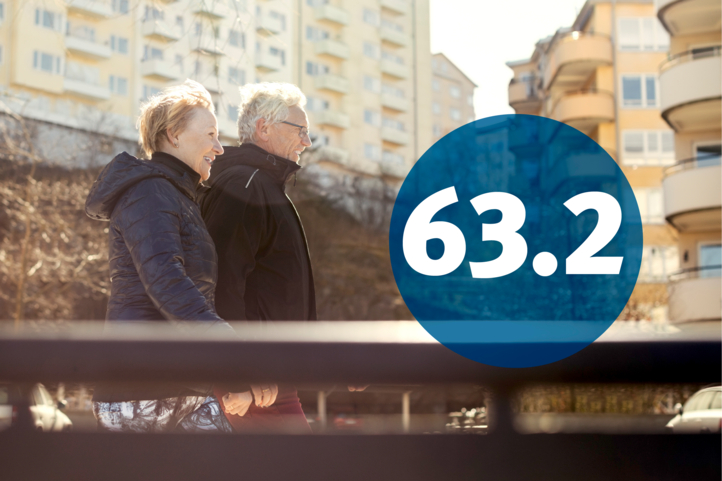
The age at which people retire on an earnings-related pension in Finland has increased faster than anticipated. Last year, the average effective retirement age was 63.2 years At the same time, the employment rate among older people continued to improve.
An important phase in Finland’s pension and labour market policy came to a close at the end of last year. As a result, people are now retiring later and have longer careers.
In 2009, the labour market organisations and the government agreed that the expected average retirement age should rise from 59.4 to at least 62.4 years. This goal was to be achieved by 2025 at the latest.
The goal was met faster than planned. According to the latest statistics from the Finnish Centre for Pensions, Finns now retire at an average age of 63.2 years. The expected effective retirement age is now almost a year higher than the original target.
Positive trend improves pension funding and supports the economy
According to Mikko Kautto, the Finnish Centre for Pensions’ Managing Director, this favourable development is underpinned by several changes to pension regulations.
“At the start of the period, the abolition of the unemployment pension delayed retirement. Towards the end of the period, raising the retirement age for the old-age pension had a similar impact.”
Changes in the nature of work, higher levels of education, and an improved ability to work have also reduced the number of people retiring on disability pensions.
Kautto emphasises that long careers are vital for the financial health of the welfare state. This amounts to several billion euros. This has strengthened the funding of the earnings-related pension scheme and increased tax revenues for both the state and municipalities.
“As people retire later and spend more years in employment, they receive better pensions,” Kautto adds.
Employment has a significant impact
The positive development is likely to continue in the future. Kautto notes that the qualifying age for the old-age pension will increase if life expectancy in Finland continues to rise.
“The trend of later retirement may therefore well persist, even though no new targets have been set.”
At the same time, Kautto points out that factors other than the rules of earnings-related pensions also influence when people retire. One such factor is that Finnish people must be in employment.
“Although governments have pledged to improve employment rates among both young people and middle-aged individuals, there has been little progress in this area.”
Potential to increase employment among older people
Jari Kannisto, Development Manager at the Finnish Centre for Pensions, also stresses the importance of employment.
“Since the 2017 pension reform, the employment rate of people aged 60 and over has increased considerably. Raising the retirement age has had a significant impact on the number of older people in the workforce, which has increased by almost 100,000 over the past decade.”
Employment among older people continued to rise last year, despite an overall decline in employment across the population.
“In the future, people aged 65 and over will be an increasingly important source of labour. In an ageing society, a growing proportion of people in this age group are already in work, yet there is still a great deal of untapped potential within this group.
40,000 Finns retire each year on the old-age pension
A total of 60,200 people retired on an earnings-related pension in 2025. Around 42,500 of them retired on an old-age pension. The remainder retired on a disability pension. The majority of those taking up an old-age pension did so at the age of 64, but one in four postponed retirement until the age of 65.
During the financial crisis, just over a third of the new retirees received an old-age pension. Now, this figure has risen to two-thirds.
The number of new retirees receiving a disability pension has dropped considerably. In 2025, one third fewer Finns retired on a disability pension than in 2008. This shift is also reflected in a significant reduction in the risk of disability.
Development of the retirement age in the 21st century
The target of raising the retirement age was set during the government of Matti Vanhanen in 2009. This goal was reiterated in the structural policy programme of Katainen’s government in 2013, as well as in the documentation surrounding the 2017 pension reform.
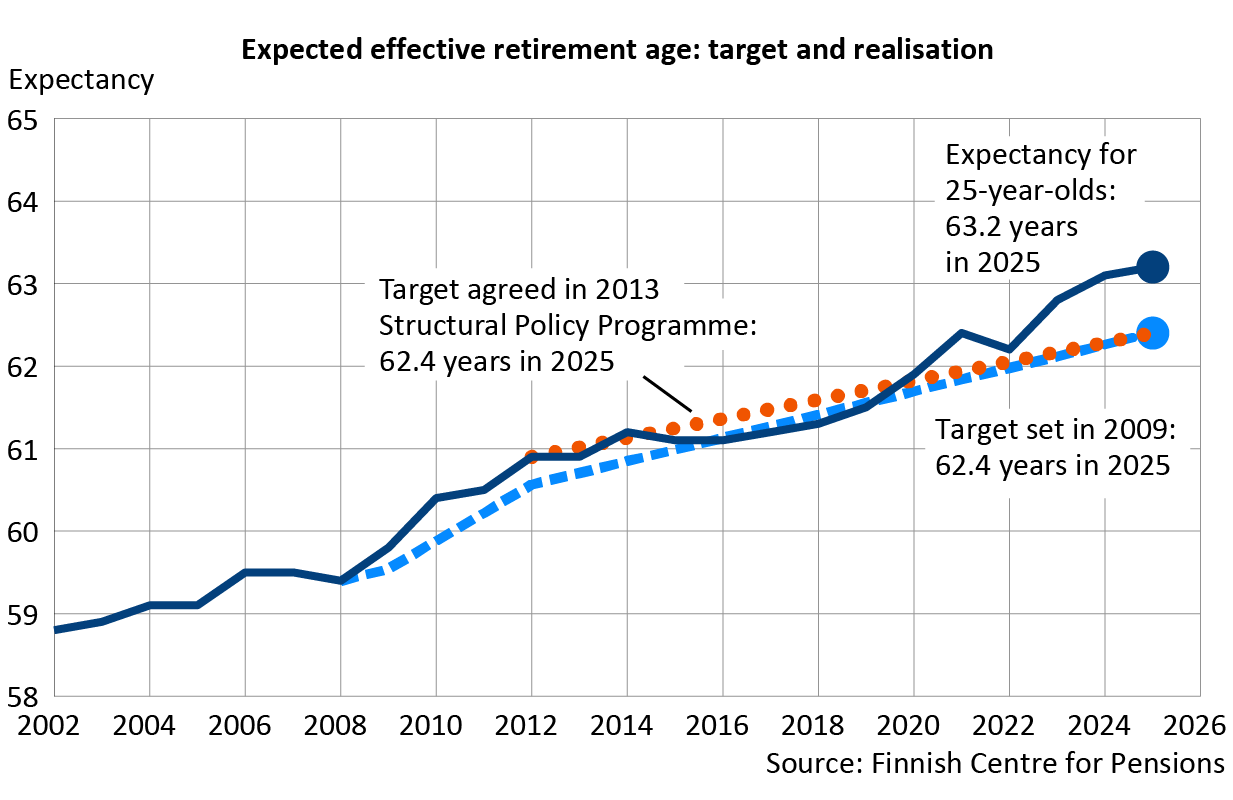
Table: Expected effective retirement age 2002-2025 (Statistical database)
The increase since 2017 has been faster than anticipated. The target age of 62.4 years was reached by 2021.
Finns are planning to retire increasingly later in life
The latest research from the Finnish Centre for Pensions shows that, between 2018 and 2023, Finns’ intended retirement age rose more quickly than the statutory retirement age.
In 2023, Finns intended to retire at an average age of 65 years and 5 months. This is 10 months later than in 2018.
Retirement intentions have proven to be a fairly reliable predictor of the actual age at which people retire.
Read more: