Pension Levels
On a regular basis, the OECD and the EU publish reports on and comparisons of pension levels in various countries. The biannual report Pensions at a Glance, published by the OECD, compares the pension level and the structure and financing of pensions in OECD countries. The most recent Pensions at a Glance report was published in November 2025. The most recent report, the Pensions Adequacy Report (PAR) was published by the European Commission in June 2024. The PAR report is published every third year.
Pensions in OECD countries
In November 2025, the OECD published an extensive survey of pensions in its different members states. Pensions at a Glance is published biannually. The selection of indicators used in the report includes, among other things, comparisons relating to the level, structure and financing of pensions. The 2025 report focuses on the gender pension gap.
Finnish earnings-related pensions at OECD average
The OECD measures the replacement rate of pensions under the assumption that a person’s working life extends from age 22 to the national retirement age (69 years in Finland). In the comparison of the replacement rate of pensions, the future pension of a Finnish employee with an average income is slightly over the OECD average when statutory and obligatory supplementary pensions are included in the comparison. The OECD average pension amounts to 52 per cent of the pre-retirement wage. The equivalent rate in Finland is 58 per cent. The replacement rate for low-income wage earners is below the OECD average (57.8% vs. 65.5%) and higher among the high-income wage earners (57.8% vs. 42.0%). For Finland, the replacement rates have not changed significantly compared to the previous review.
Previous replacement rate calculations have also examined how pension levels change in retirement. The indicator used is the replacement rate at age 80. According to the 2025 report, the average replacement rate across OECD countries drops to 45 per cent by this age. In Finland, the trend is similar. After 12 years in retirement, the replacement rate falls to around 51 per cent. These declines are mainly due to the indexation of pensions in payment, which seldom keeps pace with wage growth.
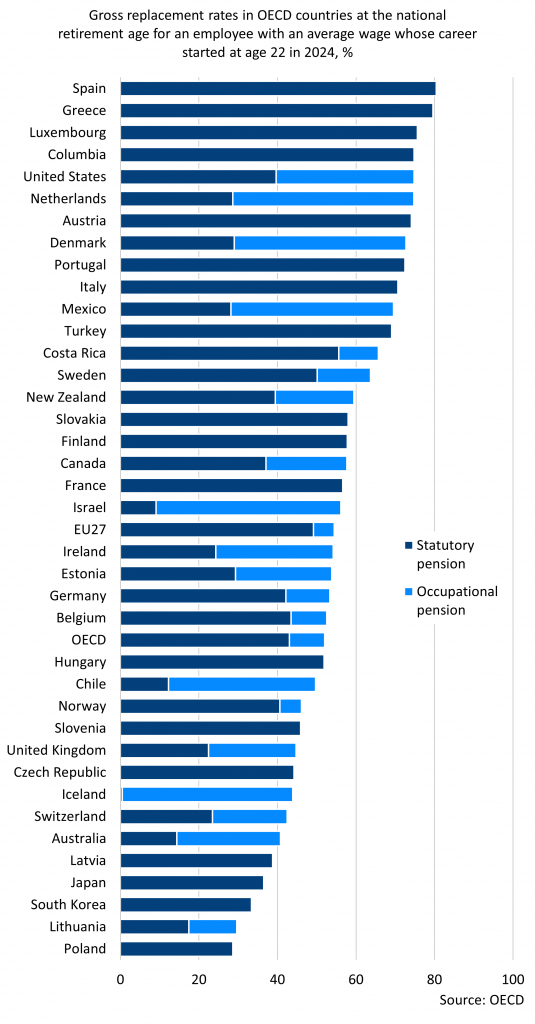
Gross pension replacement rates are highest for average earners in Greece and Spain, at around 80 per cent. In Poland, the replacement rate is just under 30 per cent, the lowest among the countries included in the comparison. In Finland, the replacement rate is above the OECD average. The calculations include both statutory pensions and occupational pensions.
Significant changes in pensions between EU countries
The Pension Adequacy Report is compiled jointly by the European Commission and the Member States. It offers an extensive overview of European pension policies, focusing on pension adequacy of old-age incomes today (2022) and in the future (2062).
The report includes numerous different indicators and alternative projections to measure the levels of old-age income provision. As a rule, the projections include the old-age pensions of the statutory pension systems. Depending on the country, the projections may also include 2nd-pillar pensions if they have broad coverage in the country. 3rd-pillar pensions are not included in the projections.
The report examines the pension levels produced by various careers through theoretical replacement rates (TRR). The pension level is reported as a net and gross replacement rate of a person with a computational working life, or as a gross pension relative to gross earnings and a net pension relative to net earnings. By reviewing different working lives, the effect of, for example, child care or part-time working on pensions, can be established. In addition, it is possible to reviews the differences in replacement rates of people who belong to different income brackets.
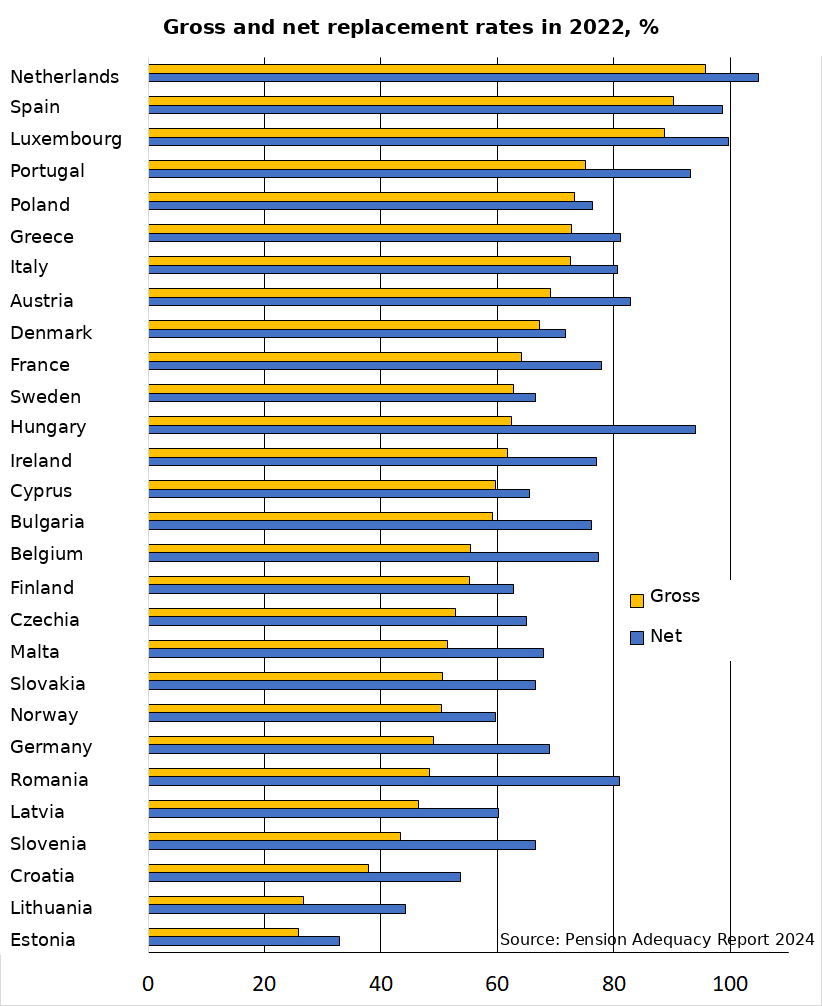
The graph below presents the replacement rates of the new base case (based on PAR data) in different EU countries. The gross and net replacement rates are those of an average income person who retires in 2022 when reaching the national retirement age after 40 years of work. In some countries, the retirement ages differ for men and women. In that case, the replacement rates are those of men. Equivalent projections have also been made for the future under the assumption that the person starts working in 2022 and retires 40 years later in 2062 at the national retirement age.
The replacement rates in EU countries vary from 33 (Estonia) to 105 (the Netherlands) per cent. The computational replacement rate for Finnish pensions is EU average. As a rule, the net replacement rates are higher than the gross replacement rates because of, among other things, taxation structures. The tax rate for higher wages tends to be higher than for lower wages, which is why the net pension and the wage are usually closer to each other.
More on other sites